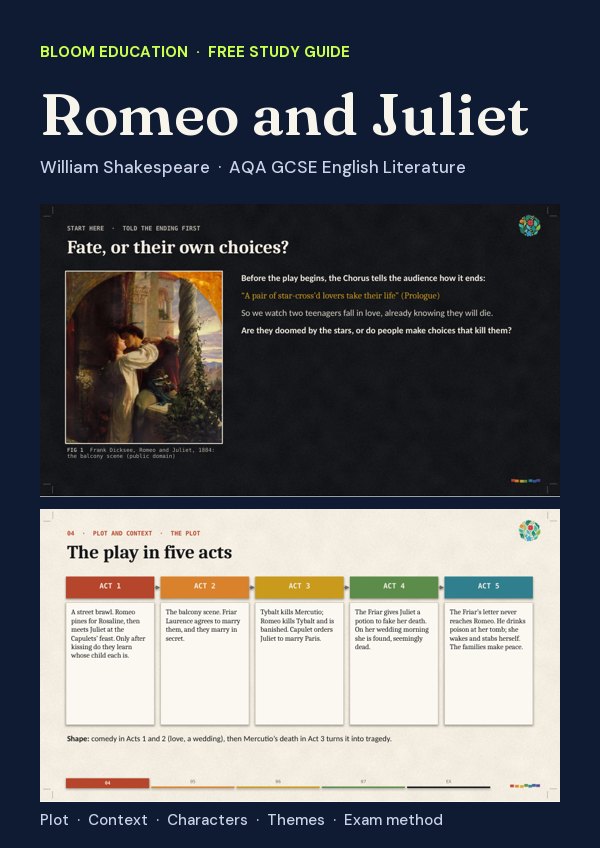
Romeo and Juliet, fate or their own choices?

Everything you need for the Romeo and Juliet question on AQA Paper 1: what happens in each act, the Elizabethan ideas behind it, how Romeo and Juliet change, the key quotations for every theme, and a step-by-step method for the extract essay.
All of this page as 29 illustrated slides, with diagrams and exam practice. No sign-up.
Download the PDF (2.8 MB)Fate, or their own choices?
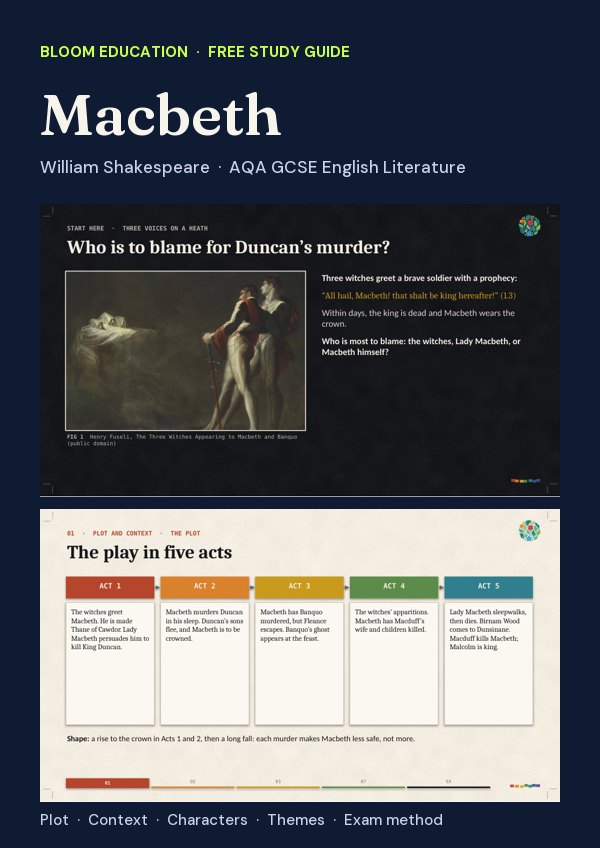
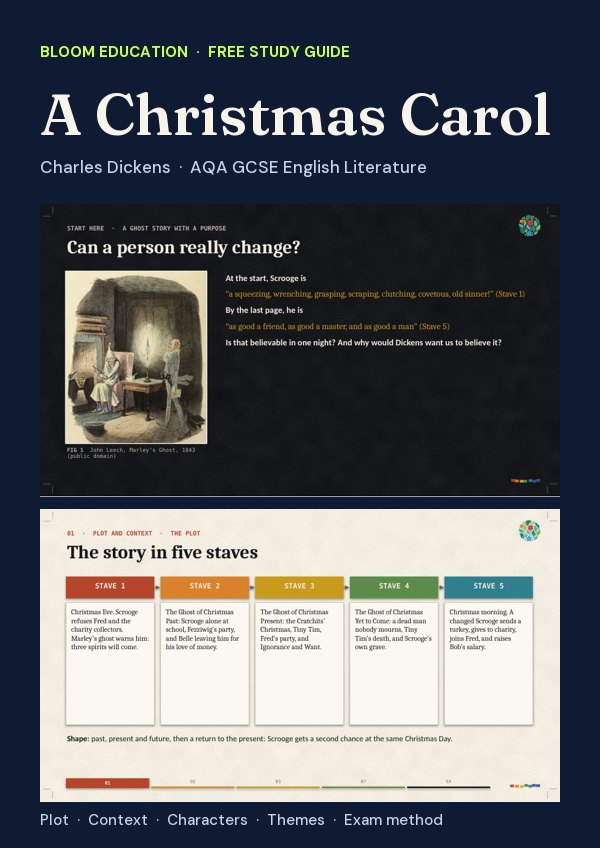
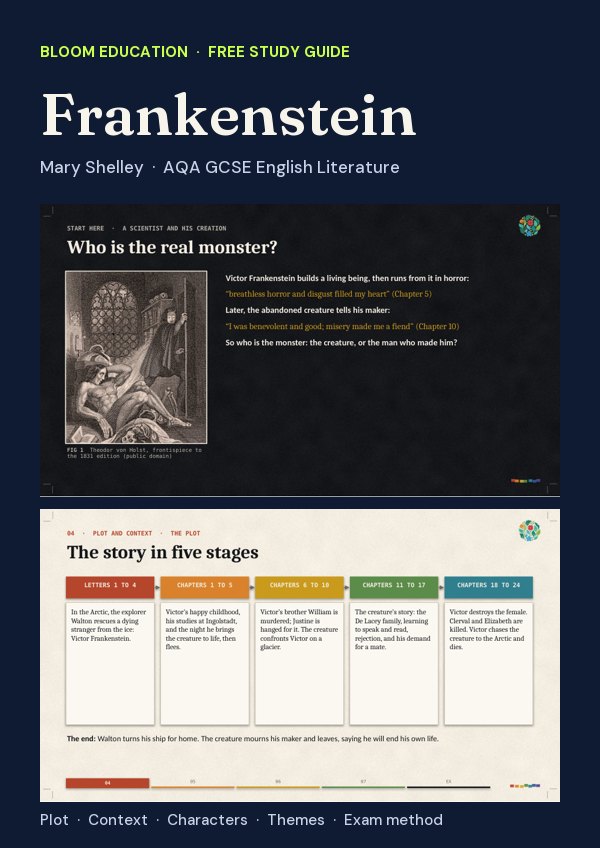
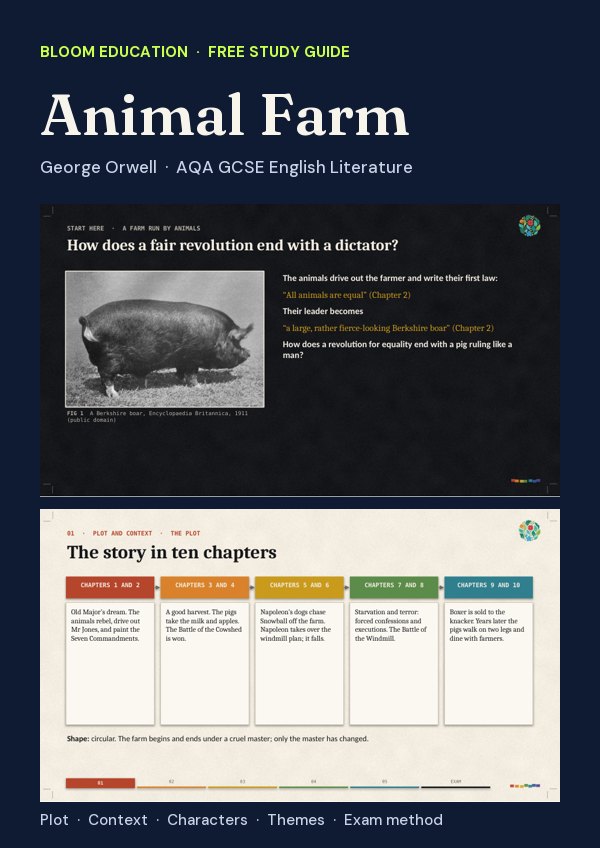
Before the play begins, the Chorus tells the audience how it ends:
“A pair of star-cross’d lovers take their life” (Prologue)
So we watch two teenagers fall in love, already knowing they will die.
Are they doomed by the stars, or do people make choices that kill them?
By the end of this guide you can...
Plot and Context
Know what happens in each act, and the Elizabethan ideas behind it.
Characters
Track how Romeo and Juliet change, and what the others are for.
Themes
Use key quotations on love, conflict, fate, family and time.
The Exam
Write about the extract, then the whole play, covering AO1, AO2, AO3 and AO4.
Follows the AQA GCSE English Literature specification (8702), Paper 1 Section A (Shakespeare).
Paper 1, Section A: Shakespeare
- The Question
- One question on Romeo and Juliet: an extract is printed; write about it and the whole play.
- The Marks
- 30 marks for the essay, plus 4 for spelling, punctuation and grammar (AO4).
- No Book
- Closed book: quotations come from memory, so learn short ones.
- Same As Macbeth
- The method is the same one used for Macbeth: extract first, then the whole play.
- AO1 Your response: a clear argument with quotations
- AO2 Shakespeare’s methods: language, form and structure
- AO3 Context: ideas and beliefs of the time
- AO4 Spelling, punctuation, grammar and vocabulary
Plot and context
What happens, act by act, and what an Elizabethan audience believed.
The play in five acts
Act 1
A street brawl. Romeo pines for Rosaline, then meets Juliet at the Capulets’ feast. Only after kissing do they learn whose child each is.
Act 2
The balcony scene. Friar Laurence agrees to marry them, and they marry in secret.
Act 3
Tybalt kills Mercutio; Romeo kills Tybalt and is banished. Capulet orders Juliet to marry Paris.
Act 4
The Friar gives Juliet a potion to fake her death. On her wedding morning she is found, seemingly dead.
Act 5
The Friar’s letter never reaches Romeo. He drinks poison at her tomb; she wakes and stabs herself. The families make peace.
Shape: comedy in Acts 1 and 2 (love, a wedding), then Mercutio’s death in Act 3 turns it into tragedy.
Elizabethan context (AO3)
- Written
- Around 1595, for an Elizabethan audience; the story is set in Verona, Italy.
- Source
- An English poem by Arthur Brooke, The Tragicall Historye of Romeus and Juliet (1562).
- Fathers
- Daughters were expected to obey their fathers, who arranged marriages for land, money and status.
- Honour
- Family honour mattered; insults could lead to duels, even though fighting in the streets was against the law.
- Fate and Faith
- Many believed the stars shaped lives. Suicide was seen as a grave sin by the Church.
Context that earns marks
Weak: Bolted on
In Elizabethan times fathers chose who their daughters married. Juliet lived in a patriarchal society.
Strong: Woven in
When Capulet calls Juliet a “disobedient wretch” (3.5), Shakespeare shows a father’s total power over his daughter; an Elizabethan audience might expect obedience, yet the violence of his words invites sympathy for her.
The test: does the context explain a choice Shakespeare makes, or how an audience reacts to one moment? If not, cut it.
Part 2 Of 4Characters
How the lovers change, and what the people around them are for.
Romeo
Impulsive, passionate, and quick to despair
- Lovesick
- “O brawling love! O loving hate!” (1.1)
- Smitten
- “For I ne’er saw true beauty till this night” (1.5)
- Devoted
- “It is the east, and Juliet is the sun” (2.2)
- Torn
- “O sweet Juliet, / Thy beauty hath made me effeminate” (3.1)
- Fate
- “O, I am fortune’s fool!” (3.1)
- Death
- “Thus with a kiss I die” (5.3)
Juliet: from child to decisive woman
Early: Dutiful But Thoughtful
“My only love sprung from my only hate” (1.5)
“It is too rash, too unadvis’d, too sudden” (2.2)
“My bounty is as boundless as the sea” (2.2)
Later: Defiant and Determined
“Give me my Romeo” (3.2)
“Wilt thou be gone? It is not yet near day” (3.5)
“O happy dagger” (5.3)
The change: she is the one who warns that their love is too fast, yet she defies her father, the Nurse and the law to keep it.
Mercutio and Tybalt
Mercutio
Romeo’s witty friend; neither Montague nor Capulet.
“Ask for me tomorrow, and you shall find me a grave man” (3.1)
“A plague o’ both your houses” (3.1)
Tybalt
Juliet’s cousin; quick to anger and proud of family honour.
“What, drawn, and talk of peace? I hate the word” (1.1)
He dies by Romeo’s sword in Act 3 Scene 1.
The turning point: Mercutio’s death in Act 3 Scene 1 turns the play from comedy to tragedy. Romeo kills Tybalt in revenge and is banished.
Friar Laurence, the Nurse and Lord Capulet
| Quotation | What it shows |
|---|---|
| “Wisely and slow; they stumble that run fast” (2.3)Friar Laurence | Good advice he does not follow: his plans fail through haste. |
| “Go, girl, seek happy nights to happy days” (1.3)The Nurse | Earthy and affectionate; later she urges Juliet to marry Paris. |
| “My child is yet a stranger in the world” (1.2)Capulet (act 1) | At first a protective father who wants Juliet to wait. |
| “Hang thee young baggage, disobedient wretch!” (3.5)Capulet (act 3) | His love turns to fury when she disobeys. |
A model paragraph, with its AOs
- AO1
- AO2 method: a metaphor, explained
- AO3 context linked to this moment
- AO4 accurate, precise writing throughout
Shakespeare presents Romeo’s love for Juliet as overwhelming and sudden. In the balcony scene he declares “Juliet is the sun”: the metaphor makes her the centre of his world, giving light and life, and it replaces the tired, clichéd language he used for Rosaline. Yet an Elizabethan audience, many of whom believed the stars shaped human lives, would remember the Prologue’s “star-cross’d” lovers, so even this joyful image of the heavens hints at the tragedy to come.
Part 3 Of 4Themes
Love, conflict, fate, family, and time and haste: with the quotations to prove them.
Love
| Quotation | What it shows |
|---|---|
| “Love is a smoke made with the fume of sighs” (1.1)Romeo (about Rosaline) | Love as misery and mist: the clichés of courtly love. |
| “Good pilgrim, you do wrong your hand too much” (1.5)Juliet | Their first words form a shared sonnet: love as holy and equal. |
| “My bounty is as boundless as the sea” (2.2)Juliet | A simile of endless, generous love. |
| “These violent delights have violent ends” (2.6)Friar Laurence | A warning that intense love burns out: foreshadowing. |
Conflict and hate
| Quotation | What it shows |
|---|---|
| “Two households, both alike in dignity” (Prologue)Chorus (prologue) | The families are equal: the feud has no just side. |
| “What, drawn, and talk of peace? I hate the word” (1.1)Tybalt | Hate as pride: he rejects peace itself. |
| “A plague o’ both your houses” (3.1)Mercutio | A curse on the feud that killed him: it comes true. |
| “See what a scourge is laid upon your hate” (5.3)Prince | The deaths are a punishment for the families’ hate. |
Fate
| Quotation | What it shows |
|---|---|
| “A pair of star-cross’d lovers take their life” (Prologue)Chorus (prologue) | Doomed by the stars from the start: dramatic irony. |
| “Some consequence yet hanging in the stars” (1.4)Romeo | A premonition before he even meets Juliet. |
| “O, I am fortune’s fool!” (3.1)Romeo | He feels like a plaything of fate after killing Tybalt. |
| “Then I defy you, stars!” (5.1)Romeo | He tries to fight fate, and in doing so fulfils it. |
Family and parents
| Quotation | What it shows |
|---|---|
| “My child is yet a stranger in the world” (1.2)Capulet | At first a caring father. |
| “Deny thy father and refuse thy name” (2.2)Juliet | Love demands rejecting family identity. |
| “Hang thee young baggage, disobedient wretch!” (3.5)Capulet | Fatherly love becomes control and insult. |
| “Out, you green-sickness carrion! Out, you baggage!” (3.5)Capulet | Shocking insults that show patriarchal power. |
Time and haste
| Quotation | What it shows |
|---|---|
| “It is too rash, too unadvis’d, too sudden” (2.2)Juliet | She fears the speed of their love: a triple of warnings. |
| “Wisely and slow; they stumble that run fast” (2.3)Friar Laurence | Advice the whole play ignores. |
| “Gallop apace, you fiery-footed steeds” (3.2)Juliet | She urges time to hurry towards night and Romeo. |
| “my mind misgives” (1.4)Romeo | A sense that events are moving too fast to control. |
Extract to whole play
How to plan the exam answer, a worked plan, and timed practice.
Extract to whole play
The 50-minute answer
- Starting with
- Begin with the extract: zoom in on words and methods.
- The Whole Play
- Then move to other moments, before and after the extract.
- Link
- Use the question’s focus word in every paragraph.
- An Arc
- Show change over the play: beginning, middle, end.
- Context
- Weave in one or two precise points; do not bolt them on.
A suggested timing
- 5 min Read the question; underline the focus word.
- 5 min Annotate the extract: 3 or 4 short quotations.
- 5 min Plan: 2 extract points, 2 whole-play points.
- 30 min Write: extract first, then the rest of the play.
- 5 min Check spelling and punctuation (AO4).
A planned answer: the balcony scene
- Extract 1
- Light imagery: “Juliet is the sun”. AO2: metaphor; she outshines all.
- Extract 2
- “kill the envious moon”: even his praise is violent, a hint of the play’s violence. AO1.
- Whole Play 1
- “O brawling love! O loving hate!” (1.1): his clichés for Rosaline show how different this is.
- Whole Play 2
- “Thus with a kiss I die” (5.3): love ends in death. AO3: fate and the stars.
But soft, what light through yonder window breaks?
It is the east, and Juliet is the sun!
Arise fair sun and kill the envious moon,
Who is already sick and pale with grief,
Question: Starting with this extract, explore how Shakespeare presents Romeo’s love for Juliet.
Fate, or their own choices?
Fate
The Prologue, Romeo’s premonitions and the undelivered letter all suggest the lovers never had a chance.
The Feud and the Adults
The families’ hate, Capulet’s forced marriage and the Friar’s risky plan push the lovers into danger.
Their Own Haste
Romeo kills Tybalt, and later drinks poison without waiting a moment longer.
A strong exam argument weighs these and then decides. The play can show fate at work through human choices: both, but in a reasoned way.
Common mistakes
Common mistakes
- Myth: Retelling the story earns marks. Marks come from analysing methods and ideas.
- Myth: It is only a love story. Hate, violence and family power are just as central.
- Myth: Wherefore means where. It means why: why are you a Montague?
- Myth: Only write about the extract. The question also asks about the play as a whole.
- Myth: Juliet is passive and weak. She proposes marriage and defies her father.
- Myth: Spelling does not matter in Literature. AO4 gives 4 extra marks on this question.
Question 1: parents and children
JULIET.
Good father, I beseech you on my knees,
Hear me with patience but to speak a word.
CAPULET.
Hang thee young baggage, disobedient wretch!
I tell thee what, get thee to church a Thursday,
Or never after look me in the face.
Speak not, reply not, do not answer me.
My fingers itch. Wife, we scarce thought us blest
That God had lent us but this only child;
But now I see this one is one too much,
And that we have a curse in having her.
Out on her, hilding.
Starting with this extract, explore how Shakespeare presents the relationship between parents and children in Romeo and Juliet.
Write about:
- how Shakespeare presents the relationship in this extract
- how Shakespeare presents it in the play as a whole.
[30 marks] AO4 [4 marks]
Allow about 50 minutes. Closed book.
Question 2: more practice titles
- Conflict
- Starting with the fight in Act 3 Scene 1, explore how Shakespeare presents conflict in Romeo and Juliet.
- Love
- Starting with the meeting at the feast (Act 1 Scene 5), explore how Shakespeare presents love.
- Juliet
- Starting with Act 3 Scene 2, explore how Shakespeare presents Juliet as a strong character.
- Fate
- Starting with Act 5 Scene 1, explore how Shakespeare presents ideas about fate.
Each: [30 marks] plus AO4 [4 marks]. Use your own copy of the play to find the extract.
Picture credits
- Romeo and Juliet (1884) · Frank Bernard Dicksee · Public domain
- The Death of Mercutio · Frank Bernard Dicksee · Public domain
Want Romeo and Juliet to click?
In a Bloom lesson, an English tutor works through the text with your child one idea at a time, then practises the exam question until it is second nature. Book a free assessment to see where your child is now.