A Christmas Carol, from flint to feather

Everything you need for the A Christmas Carol question on AQA Paper 1: what happens in each stave, the Victorian world Dickens was writing about, how Scrooge changes, the key quotations for every theme, and a step-by-step method for the extract essay.
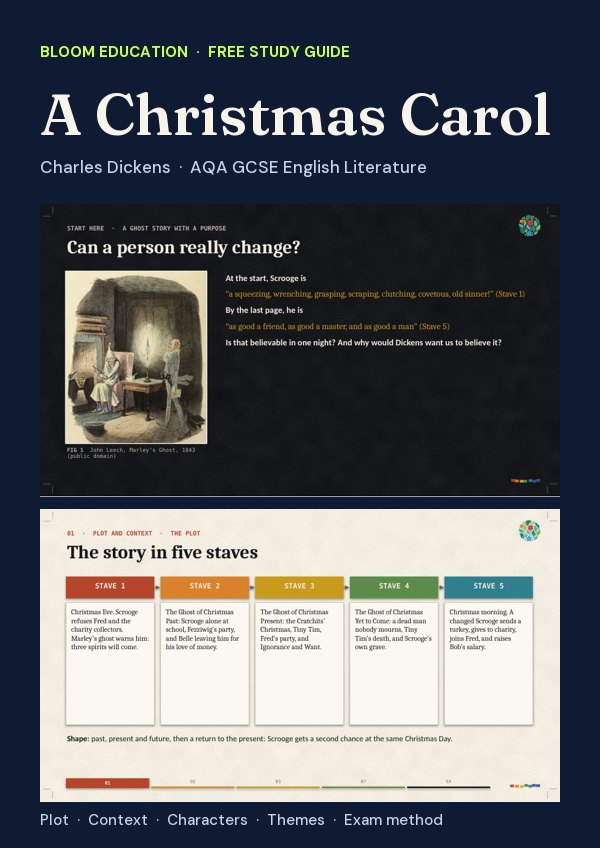
All of this page as 29 illustrated slides, with diagrams and exam practice. No sign-up.
Download the PDF (3.0 MB)Can a person really change?
At the start, Scrooge is
“a squeezing, wrenching, grasping, scraping, clutching, covetous, old sinner!” (Stave 1)
By the last page, he is
“as good a friend, as good a master, and as good a man” (Stave 5)
Is that believable in one night? And why would Dickens want us to believe it?
By the end of this guide you can...
Plot and Context
Know each stave, and the Victorian ideas Dickens was answering.
Characters
Track Scrooge’s change, and what each other character teaches him.
Themes
Use key quotations on redemption, poverty, Christmas, isolation and greed.
The Exam
Write about the extract, then the whole novel, covering AO1, AO2 and AO3.
Follows the AQA GCSE English Literature specification (8702), Paper 1 Section B (the 19th-century novel).
Paper 1, Section B: the novel
- The Question
- One question on A Christmas Carol: an extract is printed; write about it and the whole novel.
- The Marks
- 30 marks. There are no extra AO4 marks on this question.
- No Book
- Closed book: learn short, flexible quotations.
- Paper 1
- The same paper as Shakespeare (Section A): share your time evenly.
- AO1 Your response: a clear argument with quotations
- AO2 Dickens’s methods: language, form and structure
- AO3 Context: Victorian ideas and Dickens’s purpose
Plot and context
The five staves, the Victorian world behind them, and how the novella is built.
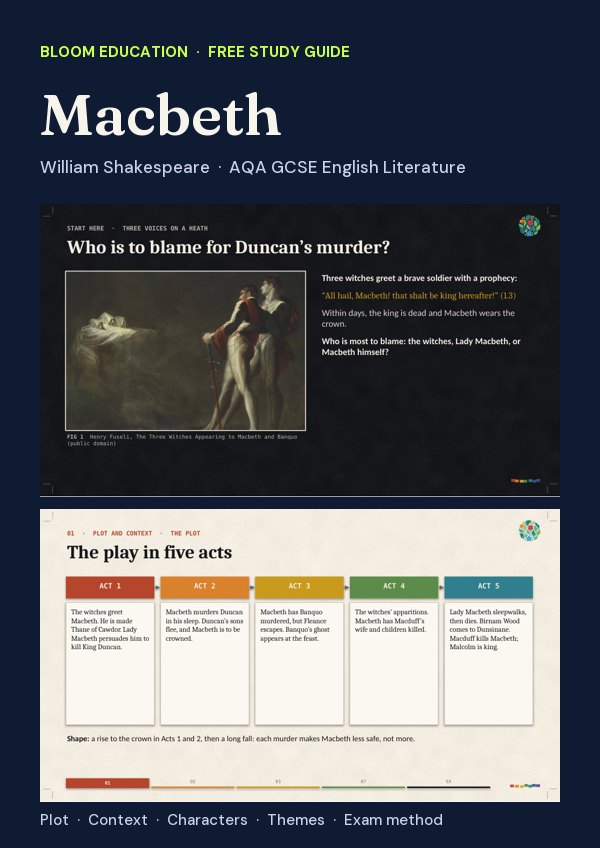
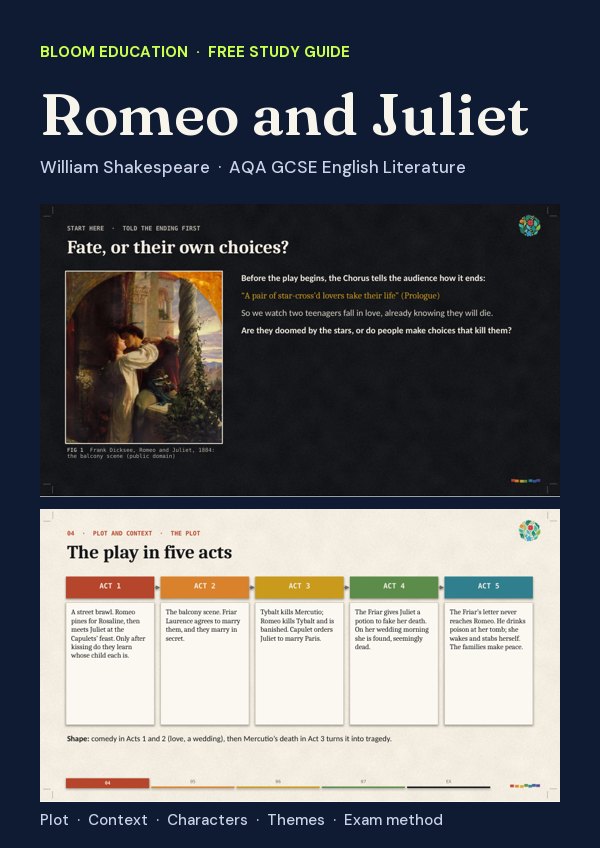
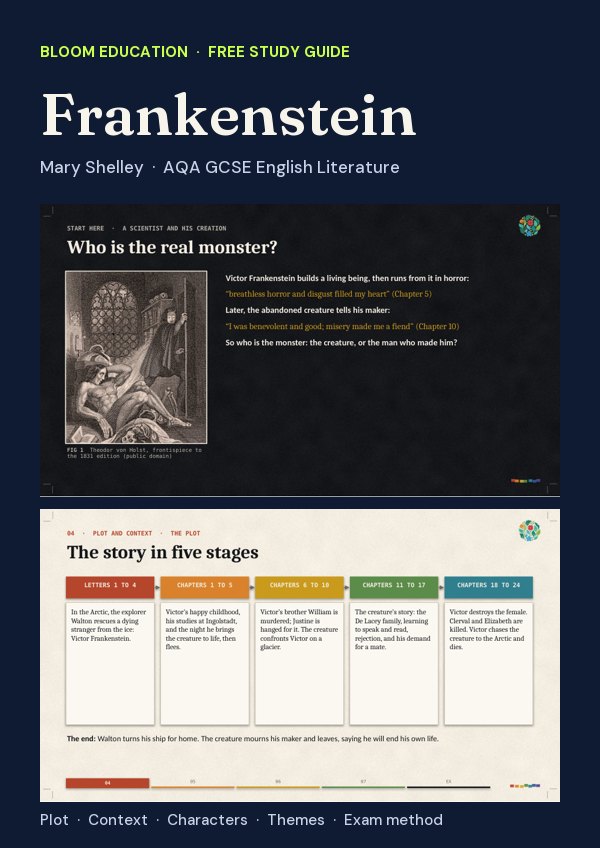
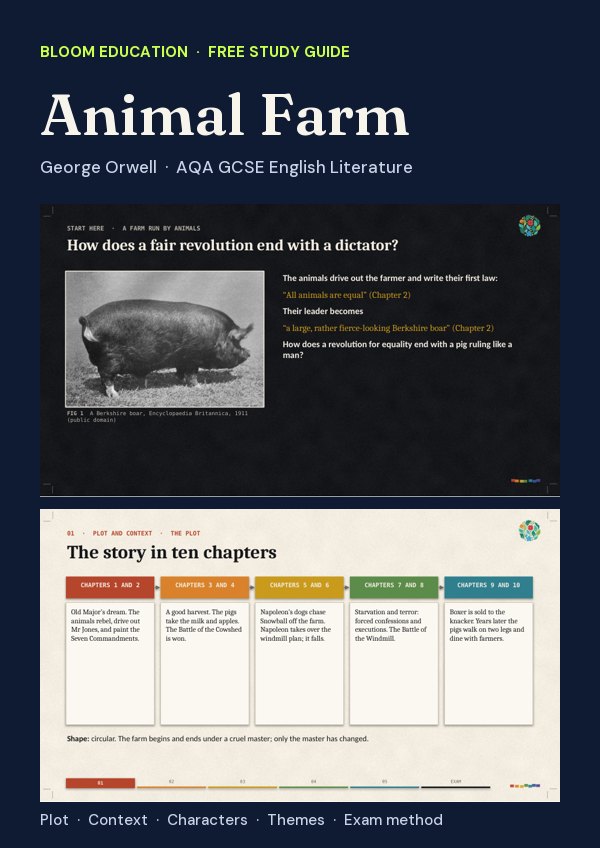
The story in five staves
Stave 1
Christmas Eve. Scrooge refuses Fred and the charity collectors. Marley’s ghost warns him: three spirits will come.
Stave 2
The Ghost of Christmas Past: Scrooge alone at school, Fezziwig’s party, and Belle leaving him for his love of money.
Stave 3
The Ghost of Christmas Present: the Cratchits’ Christmas, Tiny Tim, Fred’s party, and Ignorance and Want.
Stave 4
The Ghost of Christmas Yet to Come: a dead man nobody mourns, Tiny Tim’s death, and Scrooge’s own grave.
Stave 5
Christmas morning. A changed Scrooge sends a turkey, gives to charity, joins Fred, and raises Bob’s salary.
Shape: past, present and future, then a return to the present: Scrooge gets a second chance at the same Christmas Day.
Victorian context (AO3)
- The Poor Law
- The 1834 Poor Law Amendment Act made workhouses harsh on purpose, so the poor would avoid them.
- Malthus
- Thomas Malthus argued that population grows faster than food: hence Scrooge’s talk of a surplus population.
- Dickens
- As a boy of twelve, Dickens worked in a factory while his father was in a debtors’ prison.
- Christmas
- Christmas was becoming a family festival; the novella helped shape the Victorian idea of it.
Published in December 1843, in a London of rapid industrial growth and terrible poverty.
How the novella is built (AO2)
Form
A short novel (a novella) in five staves, like the verses of a carol.
A ghost story told by a chatty narrator who speaks straight to the reader: “MARLEY was dead: to begin with”
Structure
A circular story: each cruelty in Stave 1 is reversed in Stave 5.
Scrooge’s own words come back to him: “If he be like to die, he had better do it, and decrease the surplus population” (the Ghost, Stave 3).
Characters
Scrooge’s transformation, and what each other character shows him.
Scrooge
From flint to feather
- Cold
- “Hard and sharp as flint” (Stave 1)
- Remembering
- “He has the power to render us happy or unhappy” (Stave 2)
- Caring
- “tell me if Tiny Tim will live” (Stave 3)
- Repentant
- “I will honour Christmas in my heart, and try to keep it all the year” (Stave 4)
- Reborn
- “I am as light as a feather” (Stave 5)
Marley and the three spirits
| Quotation | What it shows |
|---|---|
| “I wear the chain I forged in life” (Stave 1)Marley (stave 1) | Greed as a chain he built himself: a warning. |
| “Mankind was my business” (Stave 1)Marley (stave 1) | He puns on business: caring for people was his real job. |
| “This boy is Ignorance. This girl is Want. Beware them both” (Stave 3)Christmas Present (stave 3) | Social problems shown as children: Dickens’s warning to society. |
| “Men’s courses will foreshadow certain ends” (Stave 4)Scrooge to Yet to Come (stave 4) | The silent spirit; Scrooge begs to learn whether the future can change. |
Fred, Belle and Fezziwig
| Quotation | What it shows |
|---|---|
| “a kind, forgiving, charitable, pleasant time” (Stave 1)Fred (stave 1) | Scrooge’s nephew defends Christmas: everything Scrooge is not. |
| “I’ll keep my Christmas humour to the last” (Stave 1)Fred (stave 1) | He refuses to be made bitter: a model of goodwill. |
| “Another idol has displaced me” (Stave 2)Belle (stave 2) | She leaves him; money has replaced love. |
| “The happiness he gives, is quite as great as if it cost a fortune” (Stave 2)Scrooge on Fezziwig (stave 2) | A good employer: kindness costs little and matters a lot. |
Bob Cratchit and Tiny Tim
The Cratchits (stave 3)
A poor family that is rich in love. Bob toasts his own mean employer: “Founder of the Feast”
Tiny Tim’s blessing: “God bless us every one!”
Tiny Tim’s Fate
In Stave 3 the Ghost warns he will die, using Scrooge’s own words. In Stave 4 the family mourns him.
In Stave 5: “Tiny Tim, who did NOT die”
Why they matter: the Cratchits put a human face on the poor. Tiny Tim’s life depends on whether Scrooge changes.
A model paragraph, with its AOs
- AO1 clear argument
- AO2 method: word choice, explained
- AO3 context linked to this moment
Dickens presents the young Scrooge as a man whose love has been replaced by greed. Belle tells him that “Another idol has displaced me”: the religious word idol suggests he now worships money like a false god, so his greed is shown as a kind of sin. Writing for a Christian Victorian readership, Dickens makes Scrooge’s love of money a spiritual failing, not just a personal one, which prepares us for the redemption that the spirits offer him.
Part 3 Of 4Themes
Redemption, poverty and responsibility, Christmas and family, isolation, and greed: with the quotations to prove them.
Redemption
| Quotation | What it shows |
|---|---|
| “I am not the man I was” (Stave 4)Scrooge (stave 4) | He pleads that he has already changed. |
| “I will honour Christmas in my heart, and try to keep it all the year” (Stave 4)Scrooge (stave 4) | A promise, not just for one day. |
| “I am as light as a feather” (Stave 5)Scrooge (stave 5) | Similes of lightness: the weight of guilt has gone. |
| “Scrooge was better than his word” (Stave 5)Narrator (stave 5) | He keeps his promises, and more. |
Poverty and responsibility
| Quotation | What it shows |
|---|---|
| “Are there no prisons?” (Stave 1)Scrooge (stave 1) | He thinks the poor are someone else’s problem. |
| “If they would rather die... they had better do it, and decrease the surplus population” (Stave 1)Scrooge (stave 1) | Malthus’s idea, voiced with shocking coldness. |
| “Mankind was my business” (Stave 1)Marley (stave 1) | Everyone is responsible for others. |
| “This boy is Ignorance. This girl is Want. Beware them both” (Stave 3)Christmas Present (stave 3) | Society’s neglect will doom it. |
Christmas and family
| Quotation | What it shows |
|---|---|
| “a kind, forgiving, charitable, pleasant time” (Stave 1)Fred (stave 1) | Christmas as a time of goodwill to all. |
| “Founder of the Feast” (Stave 3)Bob Cratchit (stave 3) | Generosity even to those who do not deserve it. |
| “God bless us every one!” (Stave 3)Tiny Tim (stave 3) | A blessing on everyone: the novella’s message. |
| “it was always said of him, that he knew how to keep Christmas well” (Stave 5)Narrator (stave 5) | Scrooge becomes the spirit of Christmas. |
Isolation
| Quotation | What it shows |
|---|---|
| “solitary as an oyster” (Stave 1)Narrator (stave 1) | Closed and hard outside; but an oyster can hold a pearl. |
| “Darkness is cheap, and Scrooge liked it” (Stave 1)Narrator (stave 1) | He chooses dark and cold to save money. |
| “A solitary child, neglected by his friends, is left there still” (Stave 2)Stave 2 | The roots of his isolation in a lonely childhood. |
| “I don’t make merry myself at Christmas” (Stave 1)Scrooge (stave 1) | He shuts himself out of the community. |
Greed and money
| Quotation | What it shows |
|---|---|
| “a squeezing, wrenching, grasping, scraping, clutching, covetous, old sinner!” (Stave 1)Narrator (stave 1) | A list of harsh verbs: greed as constant grabbing. |
| “Another idol has displaced me” (Stave 2)Belle (stave 2) | Money replaces love: a false god. |
| “I wear the chain I forged in life” (Stave 1)Marley (stave 1) | Greed imprisons after death. |
| “The happiness he gives, is quite as great as if it cost a fortune” (Stave 2)Scrooge (stave 2) | True wealth is kindness. |
Extract to whole novel
How to plan the exam answer, a worked plan, and timed practice.
Extract to whole novel
The 50-minute answer
- Starting with
- Begin with the extract: zoom in on words, narrator and structure.
- The Whole Novel
- Then move to other staves, before and after the extract.
- Link
- Use the question’s focus word in every paragraph.
- An Arc
- Show Scrooge’s change: Stave 1 to Stave 5.
- Context
- Link Dickens’s purpose to specific moments.
A suggested timing
- 5 min Read the question; underline the focus word.
- 5 min Annotate the extract: 3 or 4 short quotations.
- 5 min Plan: 2 extract points, 2 whole-novel points.
- 30 min Write: extract first, then the rest of the novel.
- 5 min Reread for clarity: no AO4 marks, but clear writing matters.
A planned answer: Ignorance and Want
- Extract 1
- Children as symbols: “This boy is Ignorance”. AO2: allegory.
- Extract 2
- “They are Man’s”: society made them. AO3: the Poor Law and neglect.
- Whole Novel 1
- “Are there no prisons?” (Stave 1): Scrooge’s cruelty to the poor.
- Whole Novel 2
- “Tiny Tim, who did NOT die” (Stave 5): change saves a poor child. AO1: Dickens’s hope.
“Spirit! are they yours?” Scrooge could say no more. “They are Man’s,” said the Spirit, looking down upon them. “And they cling to me, appealing from their fathers. This boy is Ignorance. This girl is Want. Beware them both, and all of their degree, but most of all beware this boy, for on his brow I see that written which is Doom, unless the writing be erased.”
Question: Starting with this extract, explore how Dickens presents attitudes to the poor in A Christmas Carol.
Can a person really change?
The Seeds Were There
Stave 2 shows a lonely boy and a young man who once loved: the good was buried, not missing.
Step by Step
Each spirit moves him further: memory, then pity, then fear of his own death.
Dickens’s Purpose
If even Scrooge can change, so can any reader, and so can society.
A strong exam argument says why the change is believable within the story, and why Dickens needed readers to believe it.
Common mistakes
Common mistakes
- Myth: Retelling the story earns marks. Marks come from analysing methods and ideas.
- Myth: Scrooge changes suddenly at the end. He changes stave by stave, starting in Stave 2.
- Myth: Calling it a play. It is a novella, with a narrator: write about him.
- Myth: Only write about the extract. The question also asks about the novel as a whole.
- Myth: Tiny Tim is just a sad character. He is a symbol of the poor whom society can save.
- Myth: Spelling earns extra marks here. There is no AO4 on this question, but write clearly.
Question 1: Scrooge in Stave 1
Oh! But he was a tight-fisted hand at the grind-stone, Scrooge! a squeezing, wrenching, grasping, scraping, clutching, covetous, old sinner! Hard and sharp as flint, from which no steel had ever struck out generous fire; secret, and self-contained, and solitary as an oyster. The cold within him froze his old features, nipped his pointed nose, shrivelled his cheek, stiffened his gait; made his eyes red, his thin lips blue; and spoke out shrewdly in his grating voice. A frosty rime was on his head, and on his eyebrows, and his wiry chin. He carried his own low temperature always about with him; he iced his office in the dog-days; and didn’t thaw it one degree at Christmas.
Starting with this extract, explore how Dickens presents Scrooge as a cold and isolated character.
Write about:
- how Dickens presents Scrooge in this extract
- how Dickens presents Scrooge in the novel as a whole.
[30 marks]
Allow about 50 minutes. Closed book.
Question 2: more practice titles
- Redemption
- Starting with Scrooge’s waking in Stave 5, explore how Dickens presents the idea that people can change.
- Family
- Starting with the Cratchits’ dinner in Stave 3, explore how Dickens presents the importance of family.
- The Ghosts
- Starting with Marley’s ghost in Stave 1, explore how Dickens uses the supernatural.
- The Past
- Starting with Scrooge at school in Stave 2, explore how Dickens presents the effects of the past.
Each: [30 marks]. Use your own copy of the novel to find the extract.
Picture credits
- Marley’s Ghost (1843) · John Leech · Public domain
- The Last of the Spirits (1843) · John Leech · Public domain
Want A Christmas Carol to click?
In a Bloom lesson, an English tutor works through the text with your child one idea at a time, then practises the exam question until it is second nature. Book a free assessment to see where your child is now.