Animal Farm, how a revolution goes wrong

Everything you need for the Animal Farm question on AQA Paper 2: the story in ten chapters, who stands for whom in the Russian Revolution, the key characters and quotations, Orwell’s methods, and how to plan a whole-text essay with no extract.
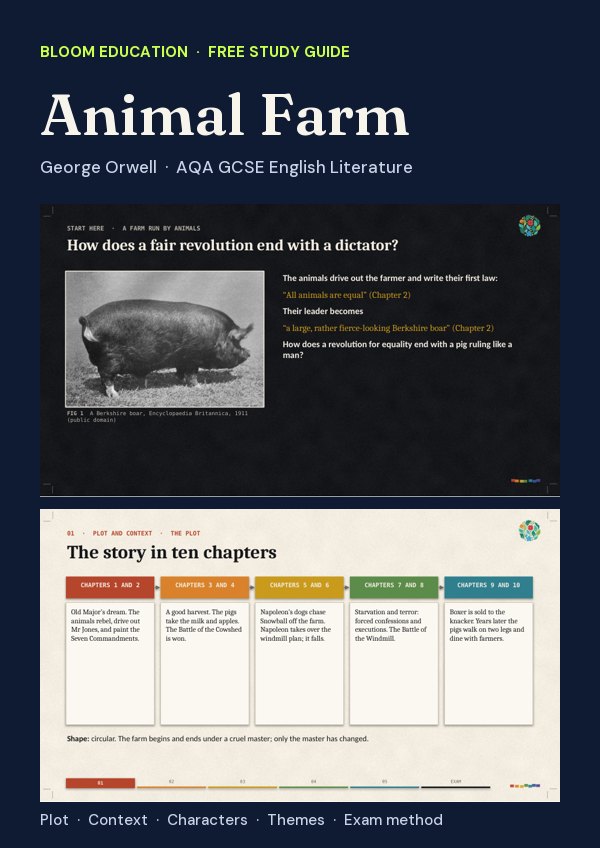
All of this page as 30 illustrated slides, with diagrams and exam practice. No sign-up.
Download the PDF (2.8 MB)How does a fair revolution end with a dictator?
The animals drive out the farmer and write their first law:
“All animals are equal” (Chapter 2)
Their leader becomes
“a large, rather fierce-looking Berkshire boar” (Chapter 2)
How does a revolution for equality end with a pig ruling like a man?
By the end of this guide you can...
Plot and Allegory
Know the story and the history of the Russian Revolution behind it.
Characters and Themes
Track the pigs’ rise and the animals’ fall, with key quotations.
Methods
Explain allegory, satire, narrative voice and the changing commandments.
The Essay
Plan and write a whole-text answer with no extract, with AO1 to AO4.
Follows the AQA GCSE English Literature specification (8702), Paper 2 Section A (modern texts).
Paper 2, Section A: the modern text
- The Choice
- Two questions on Animal Farm: answer one of them.
- No Extract
- Nothing is printed: every quotation must come from memory.
- The Marks
- 30 marks, plus 4 for spelling, punctuation and grammar (AO4).
- Paper 2
- Also on the paper: Power and Conflict poetry and unseen poetry.
- AO1 Your response: a clear argument with quotations
- AO2 Orwell’s methods: language, form and structure
- AO3 Context: the Russian Revolution and Orwell’s purpose
- AO4 Spelling, punctuation, grammar and vocabulary
Plot and context
The story in ten chapters, and the history it retells.
The story in ten chapters
Chapters 1 and 2
Old Major’s dream. The animals rebel, drive out Mr Jones, and paint the Seven Commandments.
Chapters 3 and 4
A good harvest. The pigs take the milk and apples. The Battle of the Cowshed is won.
Chapters 5 and 6
Napoleon’s dogs chase Snowball off the farm. Napoleon takes over the windmill plan; it falls.
Chapters 7 and 8
Starvation and terror: forced confessions and executions. The Battle of the Windmill.
Chapters 9 and 10
Boxer is sold to the knacker. Years later the pigs walk on two legs and dine with farmers.
Shape: circular. The farm begins and ends under a cruel master; only the master has changed.
Context (AO3)
- Stalin
- After Lenin died, Stalin drove out his rival Trotsky and ruled through fear, propaganda and purges.
- Written
- Orwell wrote the book in 1943 to 1944, while the Soviet Union was Britain’s wartime ally; publishers were wary.
- Published
- 1945, subtitled A Fairy Story.
- Orwell
- A democratic socialist: he supported equality but hated dictatorship of any kind.
The Russian Revolution overthrew the Tsar. Its leaders promised equality for workers.
Who stands for whom
- On the Farm
- Old Major
- In Russian History
- Marx and Lenin
- Battle of the Cowshed
- The civil war after 1917.
- The Windmill
- Stalin’s Five-Year Plans.
- The Confessions
- Stalin’s purges and show trials.
Mr Jones
Tsar Nicholas II
Napoleon
Stalin
Snowball
Trotsky
Squealer
propaganda
Boxer
the working class
Moses the raven
the Church
Part 2 Of 4Characters
The rulers, the workers, and the ones who stay silent.
Napoleon
From quiet pig to dictator
- Chapter 2
- quiet power
- Chapter 5
- cunning (via Squealer)
- Chapter 2
- “a large, rather fierce-looking Berkshire boar” (Chapter 2)
- Chapter 7
- terror
- Chapter 5
- “Tactics, comrades, tactics!” (Chapter 5)
- Chapter 8
- worshipped
- Chapter 7
- “the air was heavy with the smell of blood” (Chapter 7)
- Chapter 10
- a tyrant like Jones
- Chapter 8
- “Father of All Animals” (Chapter 8)
- Chapter 10
- “from pig to man, and from man to pig, and from pig to man again; but already it was impossible to say which was which” (Chapter 10)
Snowball and Squealer
Snowball
“Snowball was a more vivacious pig than Napoleon” (Chapter 2)
“liberty is worth more than ribbons” (Chapter 2)
Driven out in Chapter 5, then blamed for every disaster.
Squealer
“he could turn black into white” (Chapter 2)
“It is for YOUR sake that we drink that milk and eat those apples” (Chapter 3)
“Surely, comrades, you do not want Jones back?” (Chapter 5)
The pair: Snowball is an idealist with plans; Squealer is the voice of power, twisting words so the animals doubt their own memories.
Boxer, Benjamin and the rest
| Quotation | What it shows |
|---|---|
| “I will work harder” (Chapter 3)Boxer (chapter 3) | Loyal, strong, trusting: the exploited worker. |
| “Napoleon is always right” (Chapter 5)Boxer (chapter 5) | His second motto: blind faith in the leader. |
| “Donkeys live a long time. None of you has ever seen a dead donkey” (Chapter 3)Benjamin (chapter 3) | Cynical and clever, but he does nothing. |
| “Man is the only creature that consumes without producing” (Chapter 1)Old Major (chapter 1) | The idea that starts the revolution. |
A model paragraph, with its AOs
- AO1
- AO2 method: repetition, explained
- AO3 context linked to this moment
- AO4 accurate, precise writing
Orwell presents Boxer as loyal but tragically trusting. His motto, “I will work harder”, is short and repeated, like a slogan he has absorbed without question, so his strength becomes a tool for the pigs. As an allegory of the Russian working class, who laboured for a revolution that later betrayed them, Boxer’s sale to the knacker shows Orwell’s anger at how ordinary people are used by those in power.
Part 3 Of 4Themes
Power and corruption, language and propaganda, equality and class, and ignorance.
Power and corruption
| Quotation | What it shows |
|---|---|
| “It is for YOUR sake that we drink that milk and eat those apples” (Chapter 3)Squealer (chapter 3) | The first privilege, sold as a sacrifice. |
| “the air was heavy with the smell of blood” (Chapter 7)Narrator (chapter 7) | Power is kept by terror. |
| “Father of All Animals” (Chapter 8)Napoleon’s Titles (chapter 8) | A cult of personality. |
| “He carried a whip in his trotter” (Chapter 10)Narrator on Napoleon (chapter 10) | He has become the master he overthrew. |
Language and propaganda
| Quotation | What it shows |
|---|---|
| “he could turn black into white” (Chapter 2)Narrator on Squealer (chapter 2) | Words can make lies look true. |
| “Four legs good, two legs bad” (Chapter 3)The Sheep (chapter 3) | A slogan that drowns out debate. |
| “Four legs good, two legs BETTER!” (Chapter 10)The Sheep (chapter 10) | The same slogan, reversed. |
| “Surely, comrades, you do not want Jones back?” (Chapter 5)Squealer (chapter 5) | Fear of the past silences questions. |
Equality and class
| Quotation | What it shows |
|---|---|
| “All animals are equal” (Chapter 2)The Seventh Commandment (chapter 2) | The revolution’s founding promise. |
| “ALL ANIMALS ARE EQUAL BUT SOME ANIMALS ARE MORE EQUAL THAN OTHERS” (Chapter 10)The Wall (chapter 10) | A paradox: equality made meaningless. |
| “we have our lower classes” (Chapter 10)Mr Pilkington (chapter 10) | The pigs and the farmers share a ruling class. |
| “No animal in England is free” (Chapter 1)Old Major (chapter 1) | Still true at the end. |
Ignorance and education
| Quotation | What it shows |
|---|---|
| “I will work harder” (Chapter 3)Boxer (chapter 3) | Hard work without thought is exploited. |
| “Donkeys live a long time. None of you has ever seen a dead donkey” (Chapter 3)Benjamin (chapter 3) | Knowledge without action changes nothing. |
| “Napoleon is always right” (Chapter 5)Boxer (chapter 5) | Trust replaces thinking. |
| “Whatever goes upon two legs is an enemy” (Chapter 2)The First Commandment (chapter 2) | The animals forget their own laws. |
Methods and the essay
Allegory, satire, narrative voice, the changing commandments, and the essay without an extract.
Allegory, fable and satire
Allegory and Fable
A simple animal story with a hidden political meaning. The subtitle, A Fairy Story, is ironic: there is no happy ending.
Satire
Mocking the powerful to expose them: the pigs sleeping in beds, drinking whisky and walking on two legs are absurd and damning.
The Spontaneous Demonstrations are ordered by Napoleon: the name itself is a joke.
In the exam: name the method and say what it does: the allegory makes Stalin’s Russia easy to understand; the satire makes the pigs ridiculous as well as cruel.
The narrator who does not judge
| Quotation | What it shows |
|---|---|
| “These scenes of terror and slaughter were not what they had looked forward to” (Chapter 7)Narrator (chapter 7) | The animals’ view, told plainly: understatement. |
| “No animal shall sleep in a bed with sheets” (Chapter 6)The Wall (chapter 6) | The narrator reports the change; the reader spots the lie. |
| “Napoleon is always right” (Chapter 5)Boxer (chapter 5) | The narrator lets us hear his trust and judge it. |
The changing commandments
Chapter 2
“No animal shall sleep in a bed”
Later
“No animal shall sleep in a bed with sheets”
CHAPTER 6
“No animal shall drink alcohol”
“No animal shall drink alcohol TO EXCESS”
CHAPTER 8
“No animal shall kill any other animal”
“No animal shall kill any other animal WITHOUT CAUSE”
CHAPTER 8
“All animals are equal”
“ALL ANIMALS ARE EQUAL BUT SOME ANIMALS ARE MORE EQUAL THAN OTHERS”
CHAPTER 10
No extract
The 45-minute answer
- You Choose
- Pick the moments yourself: aim for the whole text.
- An Arc
- Beginning, middle and end: how things change.
- Memory
- Ten short quotations that fit many questions.
- The Focus
- Use the question’s key word in every paragraph.
- AO4
Four marks for accurate, varied writing.
A suggested timing
- 2 min Read both questions; choose the one you can prove best.
- 5 min Plan 4 points: beginning, middle, end, and a big idea.
- 5 min Jot one or two quotations for each point.
- 30 min Write: open with an argument, follow the text in order.
- 3 min Check spelling and punctuation (AO4).
A planned answer: Squealer and power
- Beginning
- “he could turn black into white” (Chapter 2): a gifted speaker. AO2: metaphor.
- Early
- “It is for YOUR sake” (Chapter 3): the first privilege, disguised as duty.
- Middle
- “Surely, comrades, you do not want Jones back?” (Chapter 5): fear as a weapon. AO3: Soviet propaganda.
- End
- The changed commandments (Chapter 10): the record itself is rewritten. AO1: the big idea.
Question: How does Orwell use the character of Squealer to explore ideas about power?
Argument: Squealer shows that power is kept by controlling language and memory, not just by force.
How did it end like this?
Step by Step
Small privileges (milk, apples, beds) grow until the pigs have all the power.
Words and Fear
Squealer’s lies and the dogs’ violence stop anyone questioning.
Silence
Boxer trusts, Benjamin says nothing, and the others cannot read the wall.
The last line: “already it was impossible to say which was which”: the revolution has come full circle.
Common mistakes
Common mistakes
- Myth: It is just a story about animals. It is an allegory of the Russian Revolution.
- Myth: Snowball is killed. He is driven out, then blamed for everything.
- Myth: A history essay earns the marks. Use context to explain Orwell’s methods and ideas.
- Myth: Orwell was against equality. He attacked a betrayed revolution, not its ideals.
- Myth: Tactics, comrades! is Napoleon speaking. It is Squealer, defending Napoleon.
- Myth: No extract means no quotations. Learn short quotations from across the book.
Answer ONE question
How does Orwell present the character of Napoleon as a ruler who abuses his power?
[30 marks]
AO4 [4 marks]
Write about: what happens · how Orwell presents it.
How does Orwell use the changing commandments to explore the betrayal of the revolution?
[30 marks]
AO4 [4 marks]
Write about: what happens · how Orwell presents it.
Allow about 45 minutes. No extract. Closed book.
More practice titles
- Boxer
- How does Orwell use Boxer to explore the treatment of the working class?
- Language
- How does Orwell present the power of language in Animal Farm?
- Snowball
- How does Orwell present the conflict between Snowball and Napoleon?
- Hope
- Does Orwell offer any hope in Animal Farm? Write about how he presents the animals’ dreams.
Each: [30 marks] plus AO4 [4 marks].
Picture credits
- Berkshire boar (Encyclopaedia Britannica, 1911) · F. Babbage · Public domain
Want Animal Farm to click?
In a Bloom lesson, an English tutor works through the text with your child one idea at a time, then practises the exam question until it is second nature. Book a free assessment to see where your child is now.