Macbeth, act by act and theme by theme

Everything you need for the Macbeth question on AQA Paper 1: what happens in each act, the Jacobean ideas behind it, how Macbeth and Lady Macbeth change, the key quotations for every theme, and a step-by-step method for the extract essay.
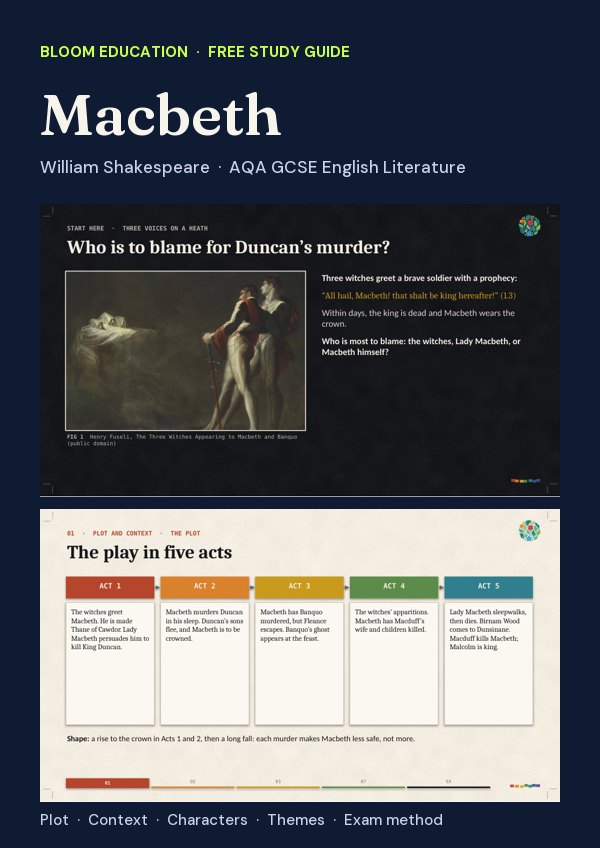
All of this page as 29 illustrated slides, with diagrams and exam practice. No sign-up.
Download the PDF (2.8 MB)Who is to blame for Duncan’s murder?
Three witches greet a brave soldier with a prophecy:
“All hail, Macbeth! that shalt be king hereafter!” (1.3)
Within days, the king is dead and Macbeth wears the crown.
Who is most to blame: the witches, Lady Macbeth, or Macbeth himself?
By the end of this guide you can...
Plot and Context
Know what happens in each act, and the Jacobean ideas behind it.
Characters
Track how Macbeth and Lady Macbeth change, and why the others matter.
Themes
Use key quotations on ambition, guilt, kingship, appearances and masculinity.
The Exam
Write about the extract, then the whole play, covering AO1, AO2, AO3 and AO4.
Follows the AQA GCSE English Literature specification (8702), Paper 1 Section A (Shakespeare).
Paper 1, Section A: Shakespeare
- The Question
- One question on Macbeth: an extract is printed, then you write about the extract and the whole play.
- The Marks
- 30 marks for the essay, plus 4 more for spelling, punctuation and grammar (AO4).
- No Book
- It is a closed-book exam: quotations must come from memory.
- Paper 1
- Section B, the 19th-century novel, is on the same paper (A Christmas Carol or Frankenstein, for example).
- AO1 Your response: a clear argument, backed by quotations
- AO2 Shakespeare’s methods: language, form and structure
- AO3 Context: ideas and beliefs of the time
- AO4 Spelling, punctuation, grammar and vocabulary
Plot and context
What happens, act by act, and what a Jacobean audience believed.
The play in five acts
Act 1
The witches greet Macbeth. He is made Thane of Cawdor. Lady Macbeth persuades him to kill King Duncan.
Act 2
Macbeth murders Duncan in his sleep. Duncan’s sons flee, and Macbeth is to be crowned.
Act 3
Macbeth has Banquo murdered, but Fleance escapes. Banquo’s ghost appears at the feast.
Act 4
The witches’ apparitions. Macbeth has Macduff’s wife and children killed.
Act 5
Lady Macbeth sleepwalks, then dies. Birnam Wood comes to Dunsinane. Macduff kills Macbeth; Malcolm is king.
Shape: a rise to the crown in Acts 1 and 2, then a long fall: each murder makes Macbeth less safe, not more.
Jacobean context (AO3)
- James I
- Written around 1606 for an audience under King James I, who was also James VI of Scotland and was said to descend from Banquo.
- Witchcraft
- James wrote a book about witches, Daemonologie (1597). Many people feared witches as agents of the devil.
- Divine Right
- Kings were believed to be chosen by God. Killing one (regicide) was a sin against God as well as a crime.
- Gunpowder Plot
- In 1605 plotters tried to blow up James and Parliament. Treason and regicide were very much in the news.
- Source
- Shakespeare took the story from Holinshed’s Chronicles, and changed it: his Banquo is innocent.
Context that earns marks
Weak: Bolted on
People in Jacobean times believed in witches. King James wrote a book about them. This is why there are witches in the play.
Strong: Woven in
When the witches chant “Fair is foul, and foul is fair” (1.1), a Jacobean audience, many of whom feared witches as servants of the devil, would hear a warning that the moral order is being turned upside down.
The test: does the context explain why Shakespeare wrote something, or how an audience would react to a specific moment? If not, cut it.
Part 2 Of 4Characters
How Macbeth and Lady Macbeth change, and what the others are for.
Macbeth
From brave soldier to tyrant
- Hero
- “For brave Macbeth (well he deserves that name)” (1.2)
- Doubt
- “We will proceed no further in this business” (1.7)
- Hallucination
- “Is this a dagger which I see before me” (2.1)
- Tormented
- “O, full of scorpions is my mind, dear wife!” (3.2)
- Despair
- “a tale / Told by an idiot, full of sound and fury, / Signifying nothing” (5.5)
- Judged
- “this dead butcher, and his fiend-like queen” (5.8)
Lady Macbeth: strength to collapse
Acts 1 and 2: in Control
“unsex me here” (1.5)
“look like the innocent flower, / But be the serpent under’t” (1.5)
“A little water clears us of this deed” (2.2)
Act 5: Broken by Guilt
“Out, damned spot! out, I say!” (5.1)
“Here’s the smell of the blood still” (5.1)
“who would have thought the old man to have had so much blood in him?” (5.1)
The reversal: in Act 2 she thinks water will wash away the guilt; in Act 5 she cannot stop washing. Shakespeare structures her story as a mirror.
Banquo and Macduff: two foils
Banquo
Hears the same prophecy, but does not act on it.
“The instruments of darkness tell us truths; / Win us with honest trifles, to betray’s / In deepest consequence” (1.3)
Macbeth fears him: “Our fears in Banquo / Stick deep” (3.1)
Macduff
Loyal to Scotland; loses his family to Macbeth.
“He has no children” (4.3)
“I must also feel it as a man” (4.3)
“Macduff was from his mother’s womb / Untimely ripp’d” (5.8)
The witches, Duncan and Malcolm
| Quotation | What it shows |
|---|---|
| “Fair is foul, and foul is fair” (1.1)The Witches | Paradox: nothing is what it seems. They speak in riddles and half-truths. |
| “Something wicked this way comes” (4.1)The Witches | Macbeth himself is now the wicked thing they sense. |
| “There’s no art / To find the mind’s construction in the face” (1.4)Duncan | A trusting king, betrayed twice: by Cawdor, then by Macbeth. |
| “the king-becoming graces” (4.3)Malcolm | He lists the qualities of a good king: the opposite of Macbeth. |
A model paragraph, with its AOs
- AO1
- AO2 method: a metaphor, explained
- AO3 context linked to this moment
- AO4 accurate, precise writing throughout
Shakespeare presents Macbeth as a man who understands that his ambition will destroy him. He admits he has only “Vaulting ambition, which o’erleaps itself”: the image of a rider who jumps too hard and falls off the other side suggests ambition is a force that defeats itself. A Jacobean audience, who believed kings were chosen by God, would see that the fall Macbeth fears is a punishment for breaking God’s order, so his murder of Duncan is shown to be doomed before it happens.
Part 3 Of 4Themes
Ambition, guilt, kingship, appearance and reality, and masculinity: with the quotations to prove them.
Ambition
| Quotation | What it shows |
|---|---|
| “Stars, hide your fires! / Let not light see my black and deep desires” (1.4)Macbeth | He hides his ambition even from the heavens: he knows it is wrong. |
| “Thou wouldst be great; / Art not without ambition” (1.5)Lady Macbeth | She sees the ambition in him and decides to feed it. |
| “To be thus is nothing, / But to be safely thus” (3.1)Macbeth | Being king is worthless unless he is safe: ambition turns to fear. |
| “I am in blood / Stepp’d in so far” (3.4)Macbeth | Like wading a river of blood: going back is as hard as going on. |
Guilt and the mind
| Quotation | What it shows |
|---|---|
| “Will all great Neptune’s ocean wash this blood / Clean from my hand?” (2.2)Macbeth | Hyperbole: guilt is too great for the whole sea to wash away. |
| “Macbeth shall sleep no more” (2.2)Macbeth (a Voice He Hears) | Sleep stands for innocence and peace: both are now lost. |
| “O, full of scorpions is my mind, dear wife!” (3.2)Macbeth | A metaphor of constant, poisonous pain inside his mind. |
| “What, will these hands / ne’er be clean?” (5.1)Lady Macbeth | Her guilt surfaces in her sleep: the blood imagery returns. |
Kingship and order
| Quotation | What it shows |
|---|---|
| “O valiant cousin! worthy gentleman!” (1.2)Duncan | A generous king who rewards loyalty. |
| “’Tis unnatural, / Even like the deed that’s done” (2.4)Old Man | After the murder nature itself goes wrong: Duncan’s horses “eat each other”. |
| “Not in the legions / Of horrid hell can come a devil more damn’d / In evils to top Macbeth” (4.3)Macduff | The rightful order sees Macbeth as worse than any devil. |
| “the king-becoming graces” (4.3)Malcolm | A good king has virtues; Macbeth is called a tyrant again and again. |
Appearance and reality
| Quotation | What it shows |
|---|---|
| “Fair is foul, and foul is fair” (1.1)The Witches | The play’s first idea: things are not what they seem. |
| “look like the innocent flower, / But be the serpent under’t” (1.5)Lady Macbeth | Echoes the serpent in the Garden of Eden: deceit as original sin. |
| “False face must hide what the false heart doth know” (1.7)Macbeth | He has learned her lesson by the end of Act 1. |
| “Is this a dagger which I see before me” (2.1)Macbeth | He cannot trust his own eyes: what is real? |
Masculinity and power
| Quotation | What it shows |
|---|---|
| “unsex me here” (1.5)Lady Macbeth | She believes cruelty belongs to men, so asks to lose her womanhood. |
| “When you durst do it, then you were a man” (1.7)Lady Macbeth | She attacks his manhood to push him to murder. |
| “I dare do all that may become a man; / Who dares do more is none” (1.7)Macbeth | A real man knows limits; Macbeth gives up this view. |
| “I must also feel it as a man” (4.3)Macduff | True manhood includes grief and feeling. |
Extract to whole play
How to plan the exam answer, a worked plan, and timed practice.
Extract to whole play
The 50-minute answer
- Starting with
- Begin with the extract: zoom in on words and methods.
- The Whole Play
- Then move to other moments, before and after the extract.
- Link
- Use the question’s focus word in every paragraph.
- An Arc
- Show change over the play: beginning, middle, end.
- Context
- Weave in one or two precise points; do not bolt them on.
A suggested timing
- 5 min Read the question; underline the focus word.
- 5 min Annotate the extract: 3 or 4 short quotations.
- 5 min Plan: 2 extract points, 2 whole-play points.
- 30 min Write: extract first, then the rest of the play.
- 5 min Check spelling and punctuation (AO4).
A planned answer: the dagger soliloquy
- Extract 1
- Questions show confusion: “Is this a dagger which I see before me”. AO2: rhetorical question.
- Extract 2
- He tries to grab it: “let me clutch thee”. The dagger leads him towards murder. AO1.
- Whole Play 1
- “Stars, hide your fires” (1.4): the desire was there before the vision.
- Whole Play 2
- “full of scorpions is my mind” (3.2): after the murder, the mind is poisoned. AO3: guilt as God’s punishment.
Is this a dagger which I see before me,
The handle toward my hand? Come, let me clutch thee:
I have thee not, and yet I see thee still.
Art thou not, fatal vision, sensible
To feeling as to sight? or art thou but
A dagger of the mind, a false creation,
Proceeding from the heat-oppressed brain?
Question: Starting with this extract, explore how Shakespeare presents Macbeth’s state of mind.
So who is to blame?
The Witches
They plant the idea, but never tell him to kill. Banquo hears them too and does nothing.
Lady Macbeth
She pushes hard in 1.7, but she is gone from the play’s centre after Act 3, and he kills on alone.
Macbeth
He knows it is wrong (“Vaulting ambition”), decides alone to kill Banquo and Macduff’s family.
A strong exam argument weighs all three and then decides. Saying ‘it is all of them equally’ is weaker than a reasoned judgement.
Common mistakes
Common mistakes
- Myth: Retelling the story earns marks. Marks come from analysing methods and ideas, not plot.
- Myth: Context means a history paragraph. Link one precise context point to a specific moment.
- Myth: The witches make Macbeth kill Duncan. They predict; he chooses. Banquo shows the choice.
- Myth: Only write about the extract. The question also asks about the play as a whole.
- Myth: Long quotations show more knowledge. Short ones (2 to 6 words) are easier to analyse.
- Myth: Spelling does not matter in Literature. AO4 gives 4 extra marks on this question.
Question 1: ambition
MACBETH.
We will proceed no further in this business:
He hath honour’d me of late; and I have bought
Golden opinions from all sorts of people,
Which would be worn now in their newest gloss,
Not cast aside so soon.
LADY MACBETH.
Was the hope drunk
Wherein you dress’d yourself? Hath it slept since?
And wakes it now, to look so green and pale
At what it did so freely? From this time
Such I account thy love. Art thou afeard
To be the same in thine own act and valour
As thou art in desire? Wouldst thou have that
Which thou esteem’st the ornament of life,
And live a coward in thine own esteem,
Letting “I dare not” wait upon “I would,”
Like the poor cat i’ th’ adage?
Starting with this extract, explore how Shakespeare presents ambition in Macbeth.
Write about:
- how Shakespeare presents ambition in this extract
- how Shakespeare presents ambition in the play as a whole.
[30 marks] AO4 [4 marks]
Allow about 50 minutes. Closed book.
Question 2: more practice titles
- Guilt
- Starting with the sleepwalking scene (Act 5 Scene 1), explore how Shakespeare presents guilt in Macbeth.
- Lady Macbeth
- Starting with Act 1 Scene 5, explore how Shakespeare presents Lady Macbeth as a powerful woman.
- The Supernatural
- Starting with Act 1 Scene 3, explore how Shakespeare presents the supernatural.
- Kingship
- Starting with Act 4 Scene 3, explore how Shakespeare presents ideas about good and bad kingship.
Each: [30 marks] plus AO4 [4 marks]. Use your own copy of the play to find the extract.
Picture credits
- The Three Witches Appearing to Macbeth and Banquo · Henry Fuseli · Public domain
Want Macbeth to click?
In a Bloom lesson, an English tutor works through the text with your child one idea at a time, then practises the exam question until it is second nature. Book a free assessment to see where your child is now.