Frankenstein, who is the real monster?

Everything you need for the Frankenstein question on AQA Paper 1: the story and its three narrators, the science and Romantic ideas behind it, Victor and his creature, the key quotations for every theme, and a step-by-step method for the extract essay.
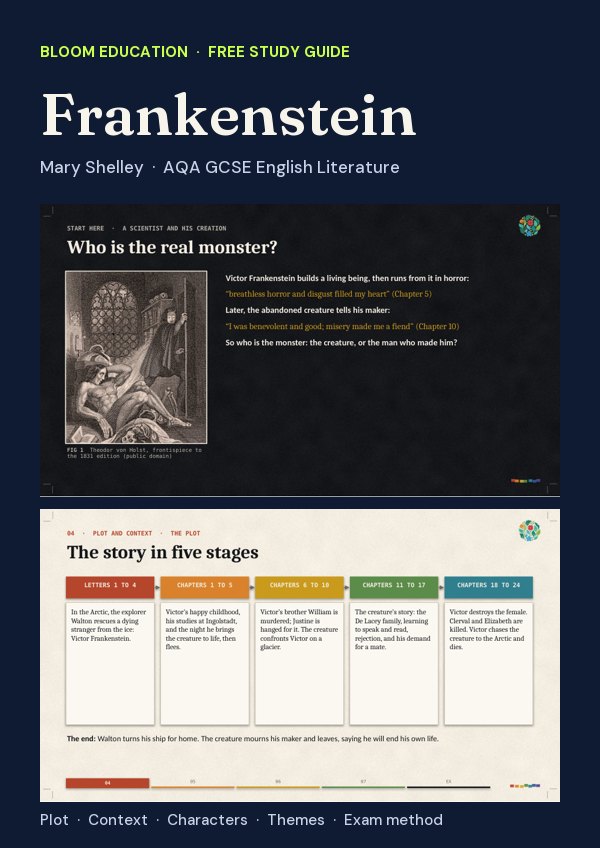
All of this page as 29 illustrated slides, with diagrams and exam practice. No sign-up.
Download the PDF (3.0 MB)Who is the real monster?
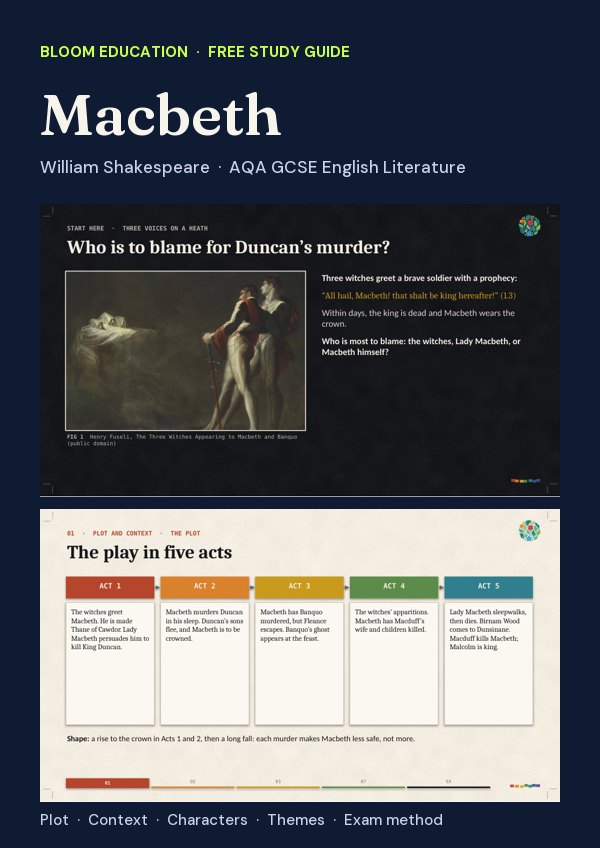
Victor Frankenstein builds a living being, then runs from it in horror:
“breathless horror and disgust filled my heart” (Chapter 5)
Later, the abandoned creature tells his maker:
“I was benevolent and good; misery made me a fiend” (Chapter 10)
So who is the monster: the creature, or the man who made him?
By the end of this guide you can...
Plot and Context
Know the story, the frame narrative, and the science and Romantic ideas behind it.
Characters
Track Victor, the creature and Walton, and what the others show.
Themes
Use key quotations on ambition, responsibility, isolation, nature and monstrosity.
The Exam
Write about the extract, then the whole novel, covering AO1, AO2 and AO3.
Follows the AQA GCSE English Literature specification (8702), Paper 1 Section B (the 19th-century novel).
Paper 1, Section B: the novel
- The Question
- One question on Frankenstein: an extract is printed; write about it and the whole novel.
- The Marks
- 30 marks. There are no extra AO4 marks on this question.
- No Book
- Closed book: learn short, flexible quotations.
- Paper 1
- The same paper as Shakespeare (Section A): share your time evenly.
- AO1 Your response: a clear argument with quotations
- AO2 Shelley’s methods: language, form and structure
- AO3 Context: science, Romanticism, and Shelley’s life
Plot and context
The story, the science and Romantic ideas behind it, and the frame narrative.
The story in five stages
Letters 1 to 4
In the Arctic, the explorer Walton rescues a dying stranger from the ice: Victor Frankenstein.
Chapters 1 to 5
Victor’s happy childhood, his studies at Ingolstadt, and the night he brings the creature to life, then flees.
Chapters 6 to 10
Victor’s brother William is murdered; Justine is hanged for it. The creature confronts Victor on a glacier.
Chapters 11 to 17
The creature’s story: the De Lacey family, learning to speak and read, rejection, and his demand for a mate.
Chapters 18 to 24
Victor destroys the female. Clerval and Elizabeth are killed. Victor chases the creature to the Arctic and dies.
The end: Walton turns his ship for home. The creature mourns his maker and leaves, saying he will end his own life.
Context (AO3)
- Published
- First in 1818; she revised it in 1831. The subtitle is The Modern Prometheus.
- Science
- Experiments with electricity (galvanism) made dead muscles twitch: could science create life?
- Romanticism
- Romantic writers valued nature, feeling and the sublime, and feared reason going too far.
- Her Life
- Her mother, Mary Wollstonecraft, died days after her birth: loss and abandonment run through the book.
Mary Shelley began the novel at 18, in a ghost-story contest with Byron and Percy Shelley near Lake Geneva.
A story inside a story inside a story (AO2)
- Frame Narrative
- Three narrators, nested like boxes.
- Why
- We hear both sides, and must judge who is right.
- The Creature’s Story, Told to Victor
- Chapters 11 to 16: the heart of the novel, in the creature’s own voice.
- Walton
- A second ambitious explorer: Victor’s story is a warning to him.
- Letters
- An epistolary frame makes the story feel real and reported.
Characters
Victor and his creature, and the people who mirror or suffer for them.
Victor Frankenstein
Brilliant, obsessive, and unable to take responsibility
- Chapter 4
- ambition
- Ambitious
- “Life and death appeared to me ideal bounds, which I should first break through” (Chapter 4)
- Chapter 5
- horror and flight
- Horrified
- “breathless horror and disgust filled my heart” (Chapter 5)
- Chapter 22
- guilt
- Warning
- “Learn from me, if not by my precepts, at least by my example, how dangerous is the acquirement of knowledge” (Chapter 4)
- Chapter 24
- warning Walton
- Guilty
- “I, not in deed, but in effect, was the true murderer” (Chapter 9)
- Dying
- “Seek happiness in tranquillity and avoid ambition” (Chapter 24)
The creature: from innocence to revenge
Born Good, Rejected
“I was benevolent and good; misery made me a fiend” (Chapter 10)
“Everywhere I see bliss, from which I alone am irrevocably excluded” (Chapter 10)
“I am alone and miserable; man will not associate with me” (Chapter 16)
Turning to Revenge
“I am malicious because I am miserable” (Chapter 17)
“if I cannot inspire love, I will cause fear” (Chapter 17)
“You are my creator, but I am your master; obey!” (Chapter 20)
Shelley’s argument: he is not born evil. Cruelty and rejection make him violent: nurture, not nature.
The creature and Paradise Lost
| Quotation | What it shows |
|---|---|
| “Remember that I am thy creature” (Chapter 10)The Creature (chapter 10) | He reminds Victor of a maker’s duty, as God to Adam. |
| “I ought to be thy Adam, but I am rather the fallen angel” (Chapter 10)The Creature (chapter 10) | Not Adam the beloved creation, but Satan the outcast. |
| “Cursed, cursed creator! Why did I live?” (Chapter 16)The Creature (chapter 16) | He curses his maker, as Satan rebels against God. |
| “I, the miserable and the abandoned, am an abortion” (Chapter 24)The Creature (chapter 24) | His final word for himself: a being rejected from birth. |
Walton, Elizabeth and the victims
| Quotation | What it shows |
|---|---|
| “I have no friend, Margaret” (Letter 2)Walton (letter 2) | Lonely and ambitious like Victor: a mirror of him. |
| “One man’s life or death were but a small price to pay for the acquirement of the knowledge which I sought” (Letter 4)Walton (letter 4) | He would risk lives for knowledge: Victor’s danger. |
| “a pretty present for my Victor” (Chapter 1)Victor’s Mother (chapter 1) | Elizabeth is presented as a gift, a possession. |
| “William, Justine, and Henry” (Chapter 22)Victor (chapter 22) | The innocent who die because of his creation. |
A model paragraph, with its AOs
- AO1 clear argument
- AO2 method: word choice, explained
- AO3 context linked to this moment
Shelley presents Victor’s reaction to his creation as a failure of responsibility. The moment it lives, he says that “breathless horror and disgust filled my heart”: the physical words breathless and disgust show his feeling is instinctive and total, and he flees instead of caring for what he has made. Shelley, whose own mother died days after she was born, makes the creature’s first experience one of abandonment, which explains much of what follows.
Part 3 Of 4Themes
Ambition and knowledge, responsibility, isolation, nature, and monstrosity: with the quotations to prove them.
Ambition and knowledge
| Quotation | What it shows |
|---|---|
| “Life and death appeared to me ideal bounds, which I should first break through” (Chapter 4)Victor (chapter 4) | He sees nature’s limits as barriers to smash. |
| “A new species would bless me as its creator and source” (Chapter 4)Victor (chapter 4) | He wants to be worshipped as a god. |
| “I had desired it with an ardour that far exceeded moderation” (Chapter 5)Victor (chapter 5) | Obsession beyond reason. |
| “how much happier that man is who believes his native town to be the world” (Chapter 4)Victor (chapter 4) | He wishes he had not wanted to know more. |
Creation and responsibility
| Quotation | What it shows |
|---|---|
| “Remember that I am thy creature” (Chapter 10)The Creature (chapter 10) | A creator owes care to what he makes. |
| “the miserable monster whom I had created” (Chapter 5)Victor (chapter 5) | He calls it a monster from its first moment. |
| “I was the slave, not the master, of an impulse” (Chapter 24)The Creature (chapter 24) | Over Victor’s body: he says revenge drove him. |
| “You are my creator, but I am your master; obey!” (Chapter 20)The Creature (chapter 20) | The roles of maker and made are reversed. |
Isolation
| Quotation | What it shows |
|---|---|
| “I have no friend, Margaret” (Letter 2)Walton (letter 2) | Even the frame narrator is lonely. |
| “Everywhere I see bliss, from which I alone am irrevocably excluded” (Chapter 10)The Creature (chapter 10) | Shut out from all human happiness. |
| “I am alone and miserable; man will not associate with me” (Chapter 16)The Creature (chapter 16) | Why he demands a mate. |
| “Hateful day when I received life!” (Chapter 15)The Creature (chapter 15) | Loneliness turns into despair. |
Nature and the sublime
| Quotation | What it shows |
|---|---|
| “These sublime and magnificent scenes afforded me the greatest consolation that I was capable of receiving” (Chapter 10)Victor (chapter 10) | Mountains calm him: the Romantic sublime. |
| “the dull yellow eye of the creature open” (Chapter 5)Victor (chapter 5) | Unnatural life, described in sickly colours. |
| “His yellow skin scarcely covered the work of muscles and arteries beneath” (Chapter 5)Victor (chapter 5) | Life made against nature looks wrong. |
| “Life and death appeared to me ideal bounds” (Chapter 4)Victor (chapter 4) | He defies nature’s laws: nature takes revenge. |
Who is the monster?
| Quotation | What it shows |
|---|---|
| “I beheld the wretch” (Chapter 5)Victor (chapter 5) | He judges by appearance in the first moment. |
| “I am malicious because I am miserable” (Chapter 17)The Creature (chapter 17) | Cruelty made him cruel. |
| “Shall I respect man when he condemns me?” (Chapter 17)The Creature (chapter 17) | A reasoned question, not a monster’s roar. |
| “I, the miserable and the abandoned, am an abortion” (Chapter 24)The Creature (chapter 24) | His final self-judgement. |
Extract to whole novel
How to plan the exam answer, a worked plan, and timed practice.
Extract to whole novel
The 50-minute answer
- Starting with
- Begin with the extract: zoom in on words, narrator and structure.
- The Whole Novel
- Then move to other chapters, before and after the extract.
- Link
- Use the question’s focus word in every paragraph.
- Narrators
- Say who is speaking: Walton, Victor or the creature.
- Context
- Link science, Romanticism or Shelley’s life to specific moments.
A suggested timing
- 5 min Read the question; underline the focus word.
- 5 min Annotate the extract: 3 or 4 short quotations.
- 5 min Plan: 2 extract points, 2 whole-novel points.
- 30 min Write: extract first, then the rest of the novel.
- 5 min Reread for clarity: no AO4 marks, but clear writing matters.
A planned answer: the creature speaks
- Extract 1
- “thy Adam” and “the fallen angel”: biblical allusion; he was owed love. AO2.
- Extract 2
- “misery made me a fiend”: cause and effect; his evil was made. AO1.
- Whole Novel 1
- “breathless horror and disgust” (Chapter 5): abandoned at birth.
- Whole Novel 2
- “I am malicious because I am miserable” (Chapter 17): rejected by the De Laceys too. AO3: nature or nurture.
Remember that I am thy creature; I ought to be thy Adam, but I am rather the fallen angel, whom thou drivest from joy for no misdeed. Everywhere I see bliss, from which I alone am irrevocably excluded. I was benevolent and good; misery made me a fiend. Make me happy, and I shall again be virtuous.
Question: Starting with this extract, explore how Shelley presents the creature as a victim.
So who is the real monster?
The Creature
He murders a child, an innocent friend and a bride. His violence is real, and deliberate.
Victor
He makes a life, abandons it, lets Justine die, and never takes responsibility.
Society
Everyone the creature meets rejects him for his looks, even the kind De Laceys.
A strong exam argument recognises that the creature’s crimes are terrible and then explains how Shelley makes us share some of the blame with Victor.
Common mistakes
Common mistakes
- Myth: Frankenstein is the monster’s name. Victor Frankenstein is the scientist; the creature has no name.
- Myth: It is told by one narrator. Walton, Victor and the creature: a frame narrative.
- Myth: Only write about the extract. The question also asks about the novel as a whole.
- Myth: The creature is evil from the start. He is gentle until rejection makes him violent.
- Myth: Film details count as evidence. No bolts or lightning in the novel: use the text.
- Myth: Context means a biography of Shelley. Link one context point to one specific moment.
Question 1: the creation
It was on a dreary night of November that I beheld the accomplishment of my toils. With an anxiety that almost amounted to agony, I collected the instruments of life around me, that I might infuse a spark of being into the lifeless thing that lay at my feet. It was already one in the morning; the rain pattered dismally against the panes, and my candle was nearly burnt out, when, by the glimmer of the half-extinguished light, I saw the dull yellow eye of the creature open; it breathed hard, and a convulsive motion agitated its limbs. How can I describe my emotions at this catastrophe, or how delineate the wretch whom with such infinite pains and care I had endeavoured to form? His limbs were in proportion, and I had selected his features as beautiful. Beautiful! Great God! His yellow skin scarcely covered the work of muscles and arteries beneath; his hair was of a lustrous black, and flowing; his teeth of a pearly whiteness; but these luxuriances only formed a more horrid contrast with his watery eyes, that seemed almost of the same colour as the dun-white sockets in which they were set, his shrivelled complexion and straight black lips.
Starting with this extract, explore how Shelley presents Victor’s attitude to his creation.
Write about:
- how Shelley presents Victor’s attitude in this extract
- how Shelley presents it in the novel as a whole.
[30 marks]
Allow about 50 minutes. Closed book.
Question 2: more practice titles
- Isolation
- Starting with the creature’s demand for a mate (Chapter 17), explore how Shelley presents loneliness.
- Ambition
- Starting with Walton’s letters, explore how Shelley presents the dangers of ambition.
- Nature
- Starting with Victor in the Alps (Chapter 10), explore how Shelley presents the natural world.
- Revenge
- Starting with the wedding night (Chapter 23), explore how Shelley presents revenge.
Each: [30 marks]. Use your own copy of the novel to find the extract.
Picture credits
- Frontispiece to Frankenstein (1831) · Theodor von Holst · Public domain
- Mary Shelley · Richard Rothwell · Public domain
Want Frankenstein to click?
In a Bloom lesson, an English tutor works through the text with your child one idea at a time, then practises the exam question until it is second nature. Book a free assessment to see where your child is now.