Every triangle is hiding a straight line. Find it, and the 180° rule explains itself.
Try it with paper
Take a paper triangle, any shape you like. Tear off the three corners. Now put them together, point to point.
They make a straight line. And a straight line is 180°. So the angles in a triangle always add up to 180°, whether the triangle is tall, flat or wonky.
It's worth doing this for real at the kitchen table. Students remember a rule they've seen work with their own hands.
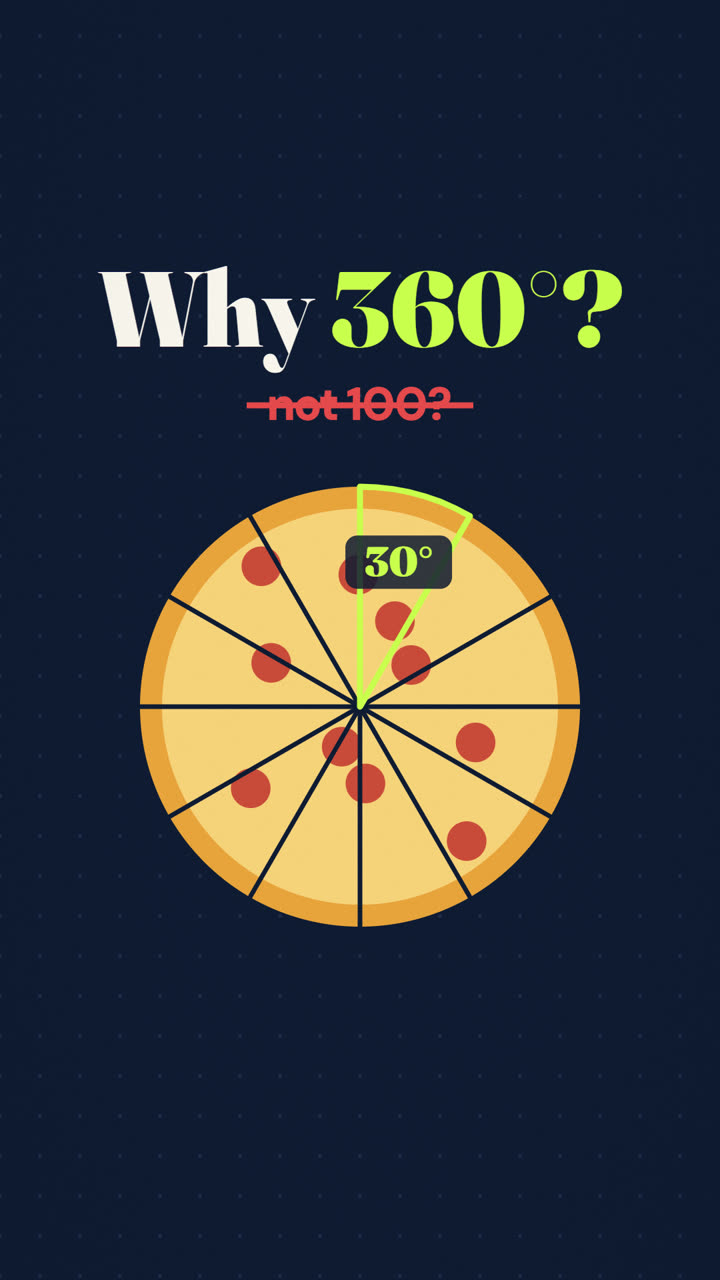
Think of half a pizza
Picture the three angles as slices of pizza meeting in the middle. Fat or thin, together they always make exactly half a pizza. Half a turn is 180°.
Worked example
A triangle has angles of 50° and 60°. What's the third?
50 + 60 = 110. Then 180 − 110 = 70. So the missing angle is 70°.
A right-angled triangle has an angle of 35°. What's the third angle?
Show the answer
A right angle is 90°. 180 − 90 − 35 = 55°.
Save this for your next test
- The angles in a triangle add up to 180°.
- Torn-off corners make a straight line.
- A straight line is 180°.
- Missing angle: add the two you know, take from 180.
Read the video transcript
- Have you ever wondered why the angles in a triangle add up to 180 degrees?
- It's because every triangle is hiding a straight line. Let me show you.
- Take a paper triangle. Any shape you like.
- Tear off the three corners.
- Now put them together, point to point.
- Look: they make a straight line.
- And a straight line is 180 degrees.
- So the angles in a triangle always add up to 180. Tall, flat, or wonky.
- Think of the three angles as slices of pizza. Fat or thin, they always make exactly half a pizza.
- Let's use it. A triangle has angles of 50 and 60 degrees. What's the third?
- 50 plus 60 is 110.
- 180 take away 110 is 70. So the missing angle is 70 degrees.
- Now you: a right-angled triangle has an angle of 35 degrees. What's the third angle? Tell me in the comments.
- Want maths to click like this? Book a free trial lesson at bloomeducationonline.com.
Want maths to click like this?
Every Bloom lesson works the same way: one idea at a time, shown before it's explained, then practised until it sticks. Book a free assessment and see it applied to your child's own work.