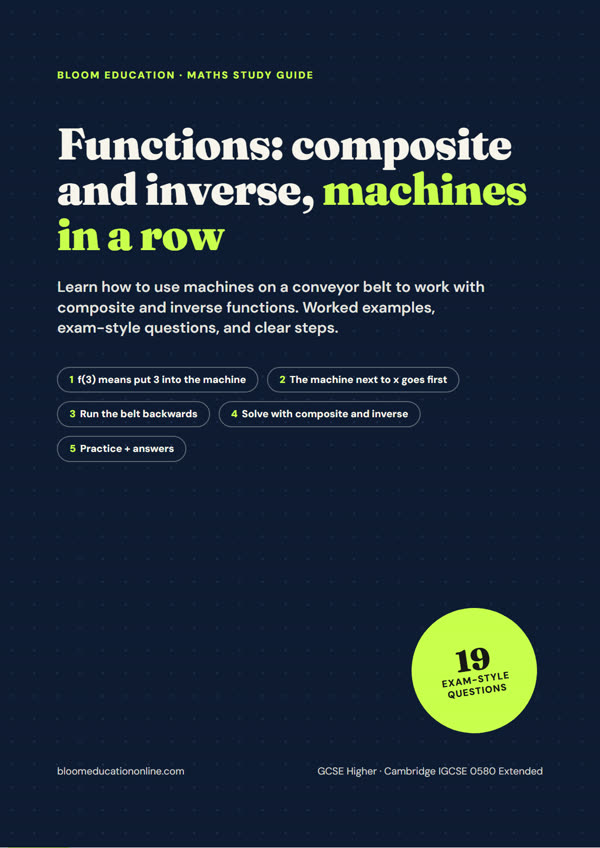
Functions: composite and inverse, machines in a row

Learn how to use machines on a conveyor belt to work with composite and inverse functions. Worked examples, exam-style questions, and clear steps.
All of this page as a 10-page guide, with every answer at the back. No sign-up.
Download the PDF (630 KB)If f(x) = 2x + 1 and g(x) = x2, why is fg(3) not the same as gf(3)?
Composite and inverse functions can feel confusing because they involve more than one step. Think of them like machines on a conveyor belt. Each function does a job, and the order matters.
The picture to keep in your head: Machines on a conveyor belt
A function is a machine: f(x) = 2x + 1 takes a number in, doubles it, adds 1, and sends it out. f(3) means 'put 3 into machine f'. A composite function fg(x) is two machines on a belt: the number goes through g first (the one nearest the x), then through f. An inverse function f-1 runs the belt backwards, undoing each step in reverse order, so it takes the output back to the input.
The method, every time
- Put the number into the machine nearest the x first.
- Take the output of the first machine and put it into the second machine.
- To find an inverse function, undo each step in the opposite order.
- Check by putting a number through the function and then through its inverse.
- Remember: inverse functions don’t mean 1 over the function.
Words you'll see
- function
- a rule (machine) that turns each input into one output
- composite function
- two functions in a row; in fg(x), g acts first
- inverse function
- f-1 undoes f: it takes the output back to the input
- input and output
- the number that goes in, and the number that comes out
f(3) means put 3 into the machine
A function is like a machine on a conveyor belt. f(3) means put 3 into the machine. The rule tells you what to do with the input. To solve f(x) = 11, you find the input that makes the machine output 11.
Watch out
- Reading f(5) as f × 5. f(5) means put 5 into the machine, not multiply f by 5.
- Forgetting brackets when substituting a negative. Use brackets to keep the negative sign with the number.
The machine next to x goes first
Think of functions like machines on a conveyor belt. When you have fg(x), the machine next to x (g) runs first. The number goes through g, then through f. Order matters—fg is not the same as gf. To find fg(x), put x into g, then put the result into f.
Watch out
- Doing f first in fg. fg means f after g—always do g first
- Multiplying f(x) by g(x). fg is not f(x) × g(x)—it’s f(g(x))
Run the belt backwards
The inverse runs the belt backwards. f(x) = (x + 5)/3 adds 5, then divides by 3, so f-1 must multiply by 3, then take away 5: the steps are undone in reverse order, like taking off shoes before socks. With algebra: write y = f(x), make x the subject, then write the result with x as the input.
Watch out
- Thinking f-1(x) means 1/f(x). The -1 means "undo", not "one over".
- Undoing the steps in the wrong order. Undo the last step first.
Solve with composite and inverse
Think of composite functions as two machines on a belt. You put a number into the first machine, then the result goes into the second. Inverse functions are like running the belt backwards. To solve problems with composite and inverse functions, build the expression for the composite function, set it equal to the value, and solve. Or use the inverse to work backwards from the answer to the input.
Watch out
- Using the wrong order for gf. Always apply the inner function first: f(x) then g(x).
- Writing f-1(x) = x - 3 instead of x + 3. Inverse of x - 3 is x + 3. Add 3 to undo subtracting 3.
19 exam-style functions: composite and inverse questions
Show your working: most marks are for the method. Marks are a guide to how much working an exam would expect. Questions written by Bloom Education in the style of GCSE (AQA, Edexcel, OCR) and Cambridge IGCSE papers.
A · Notation (Higher)
- 1Given f(x) = 3x - 2, find f(2).[2 marks]
Show the answer
4
Put 2 into machine f: 3×2 = 6, 6 - 2 = 4. Answer is 4. - 2Given f(x) = 2x + 1, find f(-3).[2 marks]
Show the answer
-5
Put -3 into machine f: 2×-3 = -6, -6 + 1 = -5. Answer is -5. - 3Given f(x) = x² + 4, find f(1/2).[2 marks]
Show the answer
17/4
Put 1/2 into machine f: (1/2)² = 1/4, 1/4 + 4 = 17/4. Answer is 17/4. - 4Given f(x) = 5x - 3, solve f(x) = 7.[2 marks]
Show the answer
2
Put x into machine f: 5x - 3 = 7. Add 3: 5x = 10. Divide by 5: x = 2. Answer is 2. - 5Given f(x) = 2x² - 5, solve f(x) = 3.[2 marks]
Show the answer
±2
Put x into machine f: 2x² - 5 = 3. Add 5: 2x² = 8. Divide by 2: x² = 4. Square root: x = ±2. Answer is ±2.
B · Composite (Higher)
- 6Given f(x) = 2x + 1 and g(x) = x - 3, find fg(2).[3 marks]
Show the answer
-1
Put 2 into g: 2 - 3 = -1. Put -1 into f: 2×(-1) + 1 = -2 + 1 = -1. - 7Given f(x) = 3x - 2 and g(x) = x + 4, find gf(-1).[3 marks]
Show the answer
-1
f first: f(-1) = 3 × (-1) - 2 = -5. Then g: g(-5) = -5 + 4 = -1. - 8Given f(x) = 4x - 1, find ff(3).[3 marks]
Show the answer
43
Put 3 into f: 4×3 - 1 = 12 - 1 = 11. Put 11 into f: 4×11 - 1 = 44 - 1 = 43. - 9Given f(x) = 2x + 1 and g(x) = x² - 4, find an expression for fg(x) and simplify.[3 marks]
Show the answer
2x² - 7
fg(x) = f(g(x)) = 2×(x² - 4) + 1 = 2x² - 8 + 1 = 2x² - 7. - 10Given f(x) = 3x - 2 and g(x) = x + 1, find an expression for gf(x) and simplify.[3 marks]
Show the answer
3x - 1
gf(x) = g(f(x)) = (3x - 2) + 1 = 3x - 1.
C · Inverse (Higher)
- 11Given f(x) = 2x + 1, find f⁻¹(7).[3 marks]
Show the answer
3
Let y = 2x + 1. Swap x and y: x = 2y + 1. Solve for y: y = (x - 1)/2. So f⁻¹(x) = (x - 1)/2. Substitute x = 7: f⁻¹(7) = (7 - 1)/2 = 3. - 12Given f(x) = (2x - 1)/5, find f⁻¹(3).[3 marks]
Show the answer
8
Let y = (2x - 1)/5. Swap x and y: x = (2y - 1)/5. Solve for y: y = (5x + 1)/2. So f⁻¹(x) = (5x + 1)/2. Substitute x = 3: f⁻¹(3) = (5×3 + 1)/2 = 8. - 13Given f(x) = 4/(x + 1), find f⁻¹(2).[3 marks]
Show the answer
1
Let y = 4/(x + 1). Swap x and y: x = 4/(y + 1). Solve for y: y + 1 = 4/x → y = (4/x) - 1. So f⁻¹(x) = (4/x) - 1. Substitute x = 2: f⁻¹(2) = (4/2) - 1 = 1. - 14Given f(x) = 3x - 2, find f⁻¹(7).[3 marks]
Show the answer
3
Let y = 3x - 2. Swap x and y: x = 3y - 2. Solve for y: y = (x + 2)/3. So f⁻¹(x) = (x + 2)/3. Substitute x = 7: f⁻¹(7) = (7 + 2)/3 = 3. - 15Given f(x) = 5 - 2x, find f⁻¹(x).[3 marks]
Show the answer
f⁻¹(x) = (5 - x)/2
y = 5 - 2x, so 2x = 5 - y and x = (5 - y)/2.
D · Mixed (Higher)
- 16Given f(x) = 2x + 3, show that ff(x) = 4x + 9.[4 marks]
Show the answer
4x + 9
f(x) = 2x + 3. ff(x) = f(2x + 3) = 2(2x + 3) + 3 = 4x + 6 + 3 = 4x + 9. - 17Find x when f(x) = f⁻¹(x) for f(x) = 2x + 1.[4 marks]
Show the answer
-1
f(x) = 2x + 1. f⁻¹(x) = (x - 1)/2. Set 2x + 1 = (x - 1)/2. Multiply both sides by 2: 4x + 2 = x - 1. Subtract x: 3x + 2 = -1. Subtract 2: 3x = -3. Divide: x = -1. - 18Given f(x) = x + 5 and g(x) = 3x, solve gf(x) = 27.[4 marks]
Show the answer
x = 4
gf(x) = g(x + 5) = 3(x + 5) = 3x + 15 = 27, so 3x = 12. - 19Solve fg(x) = 10 for f(x) = 3x + 2 and g(x) = 2x - 1.[4 marks]
Show the answer
11/6
fg(x) = f(g(x)) = f(2x - 1) = 3(2x - 1) + 2 = 6x - 3 + 2 = 6x - 1. Set 6x - 1 = 10. Add 1: 6x = 11. Divide: x = 11/6.
Functions: composite and inverse exam checklist
- fg means put x into g first, then put that result into f.
- Inverse functions undo each step in reverse order.
- Replace x with the number in the original function first.
- Check your answer by putting a number through both functions.
- Don’t mix up the order of machines or steps.
- Always write the inverse function with a superscript -1.
- Never write f-1 as 1/f — it’s a different job.
Got stuck on a question?
Find the part of this guide it belongs to and go through the worked example again, line by line. Then put your answer back into the question: if it doesn't work, look for a sign or a step you skipped.
All of this page as a 10-page guide, with every answer at the back. No sign-up.
Download the PDF (630 KB)Want maths to click like this?
Every Bloom lesson works the same way: one idea at a time, shown with a picture before it's explained, then practised until it sticks. Book a free assessment and see it applied to your child's own work.