Three sciences in one subject
Students begin learning science through the different lenses of Biology, Chemistry, and Physics.
Personalised online science support for Years 7 to 9, helping students build confidence across Biology, Chemistry, and Physics in secondary school.
Our KS3 Combined Sciences tutoring helps students strengthen their understanding across the three main science disciplines taught at this stage: Biology, Chemistry, and Physics. Whether your child is struggling with cells, particles, forces, reactions, energy, ecosystems, or general scientific reasoning, lessons are tailored to their level and focused on making science clearer, more manageable, and easier to apply in class and assessments.
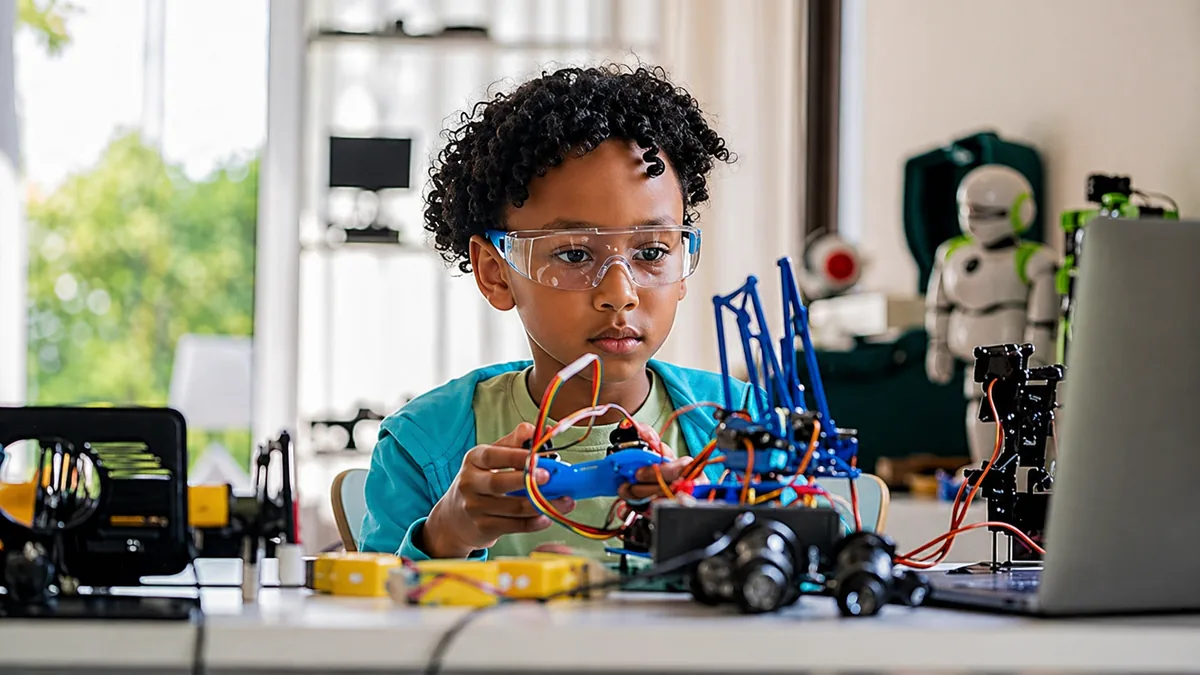
Lessons help students connect diagrams, terminology, formulas, and scientific reasoning so they can apply knowledge more confidently.
For many students, science changes significantly when they move into KS3. Instead of learning science as one broad subject, they begin working more clearly across Biology, Chemistry, and Physics. Topics become more detailed, scientific vocabulary becomes more important, and students are expected to explain processes, interpret results, and apply knowledge more independently. Our tutoring helps make that transition smoother and less overwhelming.
Students begin learning science through the different lenses of Biology, Chemistry, and Physics.
They are expected to move beyond simple facts and explain how and why things happen.
Key terminology becomes increasingly important in lessons, homework, and assessments.
The work covered in KS3 forms an important base for future Combined Science or separate science study at GCSE.
Our tutors can support students in one science area or across all three, depending on where help is needed. Some students feel comfortable in one area but struggle in another, so lessons can be targeted very specifically.
This includes living organisms, cells, body systems, reproduction, ecosystems, health, and the processes that affect life.
This includes particles, elements, compounds, mixtures, reactions, acids and alkalis, the periodic table, and understanding how substances behave.
This includes forces, motion, energy, electricity, light, sound, pressure, and the physical laws that explain how the world works.
Lessons can focus on one branch of science at a time or combine support across the full KS3 science curriculum.
Our tutors support students across the main KS3 science topics commonly taught in UK secondary schools. Lessons can focus on a specific unit your child is covering in class or help reinforce broader scientific understanding.
Cells and organisation, movement and body systems, nutrition and digestion, reproduction, health and disease, ecosystems and food chains, interdependence, plant reproduction and structure, and variation and inheritance basics.
Particles and states of matter, elements, compounds, mixtures, atoms and simple atomic ideas, chemical reactions, acids and alkalis, metals and non-metals, the periodic table, separation techniques, and properties of materials.
Forces and motion, energy transfers, light, sound, electricity and circuits, magnetism, pressure, space, and heat and temperature basics.
Planning investigations, making predictions, recording results, interpreting data, identifying patterns, evaluating methods, and using evidence in explanations.
Many students enjoy science but still begin to struggle when the subject becomes more detailed and divided into separate branches. Difficulties often come from a mix of knowledge gaps, unfamiliar vocabulary, and uncertainty about how to explain scientific ideas.
Key words become harder to remember and use accurately in written answers.
Students can mix up Biology, Chemistry, and Physics ideas when topics move quickly.
Labelled diagrams, graphs, circuits, and models often need careful explanation.
Some students understand the lesson but struggle to use that knowledge in questions.
Planning, variables, results, and evaluation can feel unfamiliar.
Students often need help explaining answers clearly with the right terminology.
One missed unit can make later classwork feel harder to follow.
Confidence can drop when new vocabulary and content arrive before earlier ideas feel secure.
Our tutors help students understand the content more clearly while also showing them how to think through scientific questions more effectively.
Each lesson is designed to strengthen both knowledge and understanding. Tutors help students learn the content, understand the underlying ideas, and improve the way they answer science questions in class and assessments.
The lesson often begins by identifying what the student already knows and where confusion or gaps may be affecting progress.
The tutor introduces the topic clearly, whether it is cells, chemical reactions, electricity, or another area of science.
Scientific ideas are broken down into manageable parts using diagrams, examples, and step-by-step explanation.
The student works through questions or topic tasks with support so they can apply the knowledge correctly.
Tutors help students answer more clearly, use the right terminology, and avoid common mistakes.
The goal is to help students become more secure across science topics and more independent in the way they think and respond.
KS3 is where many of the important foundations for later science study are built. If a student becomes unsure about scientific vocabulary, core concepts, or the way science questions work at this stage, that uncertainty often continues into GCSE. Early support can make a major difference by helping students build understanding before the subject becomes even more demanding.
Earlier support stops weak areas becoming larger GCSE problems.
Students feel more secure early in secondary school.
Support across all three sciences helps the subject feel less fragmented.
Students learn how to explain ideas with stronger terminology and structure.
Harder areas can be slowed down and retaught clearly.
A stronger base makes GCSE science feel more manageable.
The aim is not only to improve short-term performance, but to build a stronger foundation for long-term science success.
This is often a big adjustment year. Students begin secondary science in a more structured way and start working across Biology, Chemistry, and Physics topics with greater detail.
Tutoring can help students strengthen understanding, improve recall, and keep up as scientific ideas become broader and more demanding.
This year often becomes especially important as students consolidate the KS3 curriculum and prepare for the next stage of science study.
Lessons are tailored to the student's year group, school progress, and confidence level, whether they need help catching up, staying on track, or building a stronger base for GCSE.
Parents often seek tutoring because they want their child to understand science more clearly, stop falling behind, and feel more confident across the subject. One-to-one support gives students more time to ask questions, revisit difficult ideas, and improve at a pace that suits them.
Students gain clearer knowledge in Biology, Chemistry, and Physics.
Tutoring helps students become more comfortable with the language used in science lessons and assessments.
As understanding improves, students often feel more able to participate in class and attempt questions independently.
Students learn how to explain processes, use key terminology, and respond more effectively to science questions.
Tutoring helps students feel better prepared for topic tests, end-of-term checks, and classroom tasks.
The work done in KS3 Combined Sciences supports future success in science at the next level.
If your child is struggling with a particular topic from class, lessons can be tailored directly to that area.
If your child is struggling with a particular topic from class, lessons can be tailored directly to that area.
With the right support, students can strengthen their understanding, improve their confidence, and make better progress across Biology, Chemistry, and Physics throughout Years 7 to 9. Whether your child needs help with one science area or broader support across the subject, one-to-one tutoring can provide focused guidance that makes a real difference.
Book a KS3 Science LessonGet in touch to find the right science tutor for your child's year group and needs.
Focused support for Biology, Chemistry, Physics, scientific vocabulary, investigations, written answers, and GCSE foundations.